
For most readers switching away from Smallpdf, we recommend FlowPDF because it processes every file locally in your browser, so nothing uploads to a server. You get core tools for editing, merging, splitting, compressing, and signing, at no cost and without watermarks. Below, we walk through the categories of alternatives, a checklist to verify any tool's privacy claims, and how to get started.
TL;DR:
- Use an in browser local tool for occasional private tasks; choose desktop software for large batches or repeated OCR, and verify operating system support before installing.
- Check local processing by monitoring network traffic during editing and repeating the task offline; an offline mode label alone does not prove files stay local.
- Before committing, test text edits, merging, splitting, compression, signing, OCR, redaction, form filling, and export, then check file size and mobile browser support.
- Verified identity signatures and compliance workflows with audit trails may require paid or desktop software, unlike ordinary student, freelance, and small business tasks.
Table of Contents
- Why People Switch Away From Smallpdf
- Three Categories of PDF Tools and Which Fits Your Workflow
- How to Verify a Tool Actually Processes Files Locally
- Matching Your Needs to the Right PDF Tool
- What We Built Into FlowPDF and How to Confirm It Yourself
- Privacy-First Browser Tools vs. Installed Software
- Try FlowPDF for Your Next PDF Task
- FAQ
- Sources
Why People Switch Away From Smallpdf
Most switches come down to four frustrations: files get uploaded to a third party, daily task limits block a workflow mid-edit, a needed editing feature is missing, or the price climbs once you need more than the free tier allows. If you handle contracts, medical forms, or financial statements, uploading to an unknown server is the dealbreaker, making remote work tools and resources for digital nomads essential for maintaining privacy across devices.
Local processing means your file is read, edited, and saved by code running in your own browser or on your own device. It never travels over the network to a remote server. That distinction matters for anyone working with sensitive paperwork, because a file that never leaves your device cannot be intercepted, logged, or retained somewhere you cannot see.
Before comparing specific tools, judge each candidate against the same checklist:
- Privacy: does the tool state, clearly, that files are processed locally or encrypted end to end?
- Core features: can it edit text, merge, split, compress, sign, and handle OCR or scans?
- Task limits: is there a daily cap, file size ceiling, or page limit on the free tier?
- Price: is the free tier genuinely usable, or does it funnel you toward a paid plan mid-task?
- Platform support: does it work in your browser, on mobile, and across operating systems?
Running every candidate through this same five-point check keeps the comparison honest and saves you from picking a tool based on a flashy homepage instead of what it actually does with your files.
Three Categories of PDF Tools and Which Fits Your Workflow
Once you know what to check for, it helps to sort alternatives into three broad categories rather than evaluating them one by one.
In-browser local tools run entirely inside your browser tab using modern web technology. The file never leaves your device, there is nothing to install, and edits happen almost instantly. This category suits quick, occasional tasks, like merging two contracts or compressing a scan before an email, where privacy matters and you do not want software taking up space on your hard drive.

Desktop apps install directly on your computer and process everything offline once installed. They tend to handle heavy or batch work better, such as compressing hundreds of files or running OCR across a large archive, but you need to confirm OS compatibility and accept an installation step. Community discussions, including a self-hosted alternatives thread on Reddit, point to self-hosted and WebAssembly-based builds as technical routes toward this same local-first guarantee, though they require more setup than a click-and-use browser tool.
Cloud tools with local or offline modes offer a hybrid: some processing happens on your device, some still touches a server. These can be convenient for teams that need shared links or cloud backup, but the "offline mode" label does not always mean full local processing, so it is worth confirming before trusting it with sensitive files.
- Choose in-browser local tools for privacy-first, occasional, single-file tasks.
- Choose desktop apps for frequent, heavy, or batch processing where installation is acceptable.
- Choose hybrid cloud tools only when collaboration matters more than keeping every file off a server.
How to Verify a Tool Actually Processes Files Locally
Claims about privacy are easy to make and harder to confirm. Here is a short routine to test any tool, including the one you already use:
- Open your browser's developer tools and watch the network tab while you upload and edit a file; if you see no outbound file transfer, that is a strong signal of local processing.
- Disconnect from the internet, then try to complete the edit; a genuinely local tool keeps working offline.
- Read the vendor's privacy page for specific language like "processed in your browser" or "files never leave your device" rather than vague reassurances.
- Run a full multi-step task, editing text, merging pages, then exporting, to see whether a paywall or watermark appears only after you have invested time.
- Test a large file and a mobile browser to check how the tool handles size limits and slower connections.
Pro Tip: Always run the disconnect test before trusting a tool with a sensitive document: if the edit stops working offline, your file is being sent somewhere.
The core tasks worth testing on any candidate are text editing, merge and split, compression, digital signing, OCR or scan import, redaction, form filling, and export to common formats like Word or JPEG. A tool that handles all of these without ever asking you to create an account is rare enough to be worth noting when you find it.
Matching Your Needs to the Right PDF Tool
Your priorities decide which category and which tool make sense.
- If privacy is your top concern, whether you handle legal, medical, or financial documents, an in-browser local tool is the safest default because nothing uploads.
- If you process large batches daily, a desktop app with offline OCR and bulk compression will likely save more time than a browser tool refreshed for each file.
- If your edits are occasional and simple (sign one form, compress one scan before emailing), a browser tool gets you in and out fastest.
- If you work mostly from a phone, confirm mobile browser support before committing to any option, since not every in-browser tool renders well on small screens.
Mapped to common profiles: a student merging lecture notes and signing a permission slip fits an in-browser tool. A freelancer editing and redacting client contracts needs the same privacy guarantee, used more often. A small-business admin handling invoices and forms benefits from a tool that supports fill-in forms and page numbering without a subscription. Legal or HR staff redacting sensitive pages need local processing paired with redaction and protect/unlock features.
FlowPDF fits each of these profiles because it keeps processing local, covers a broad feature list, and charges nothing. Getting started takes three steps: open the tool for the task you need, make your edit, and export, with no signup required at any point.
What We Built Into FlowPDF and How to Confirm It Yourself
We designed FlowPDF around one principle: your document stays on your device. Every edit, merge, split, or compression runs in your browser, so we never see or store the file you are working on.
- Local processing by default: we built every tool, including editing PDFs without uploads, to run client side, with no server round trip for your file.
- Full feature access, no watermark: merging, splitting, compressing, signing, redacting, and form-filling are all included, and nothing gets stamped onto your exported file.
- No signup required: you open the tool and start working immediately.
You do not have to take our word for it. Open your browser's network tab while using any FlowPDF tool and watch for outbound file transfers, or disconnect from the internet mid-edit and confirm the task still completes. Both checks are the same ones we described earlier in this guide, and they apply equally to FlowPDF as to any competitor you are evaluating.
Privacy-First Browser Tools vs. Installed Software
Our take: for the overwhelming majority of everyday PDF tasks, a privacy-first browser tool beats installed software on convenience without giving up anything on security. You avoid an install, a login, and a server upload, and you get your file back in seconds.
The exception is narrow but real. Enterprise contract signing that requires a certified digital signature tied to a verified identity, or compliance workflows with audit trails, often calls for dedicated paid or desktop software built for that specific legal standard. Outside that case, browser-based local tools cover nearly everything a student, freelancer, or small business needs.
— Ronald Ang
Try FlowPDF for Your Next PDF Task
We built FlowPDF to answer exactly the checklist in this guide: local processing, no uploads, full feature access, and no watermark. Whether you need to edit text, merge contracts, split a scanned packet, compress a large file, or sign a form, each tool runs the same way, in your browser, on your device, free of charge.
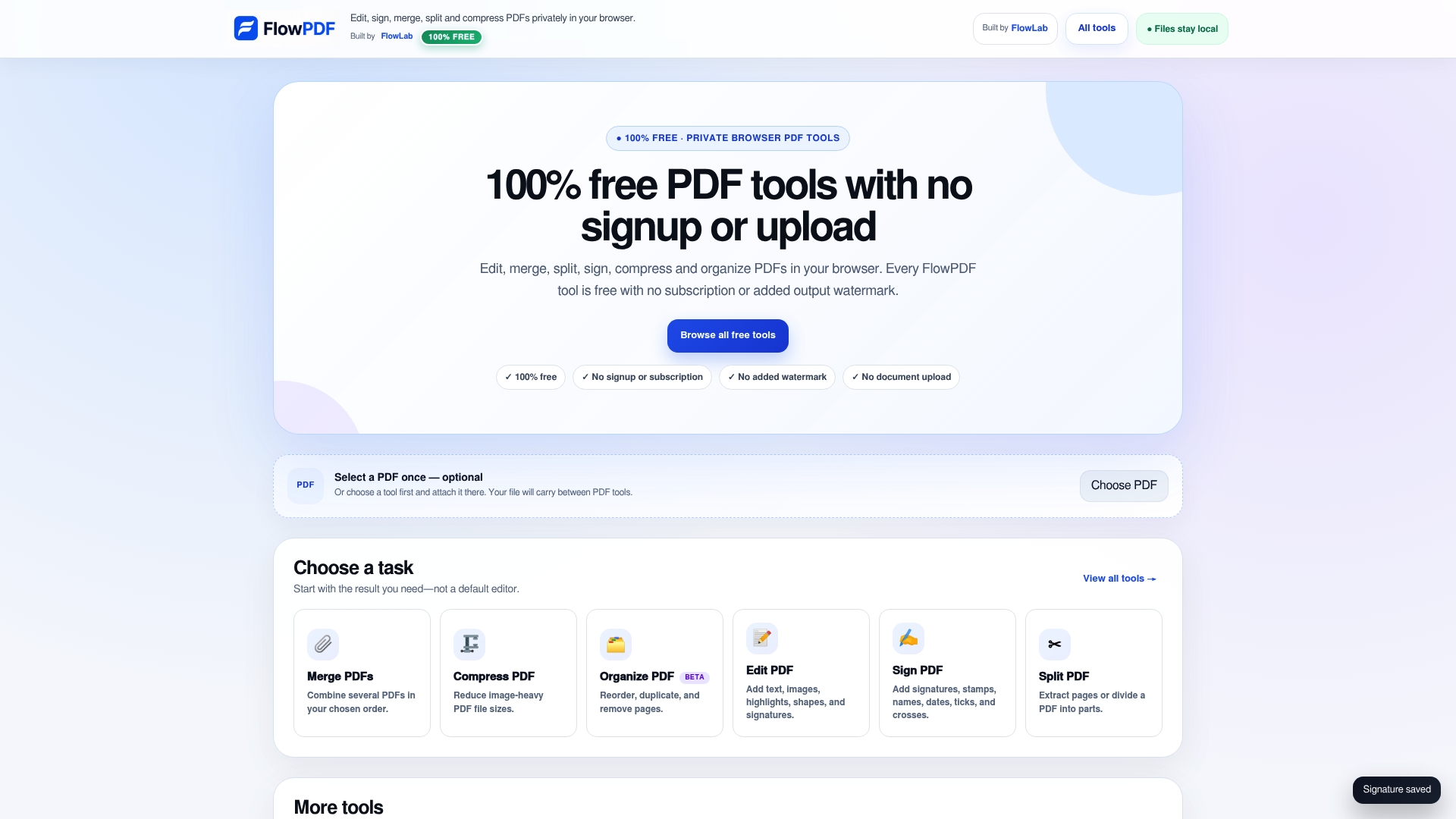
- Open our free PDF tools page and pick the task you need.
- Run your edit, then confirm it stayed local using the network tab or offline test described above.
- Export your finished file immediately, with no account and no watermark.
If you handle PDFs often enough to care who sees them, start with our editor and judge the result for yourself.
FAQ
What makes a PDF tool private compared to Smallpdf?
A private PDF tool processes your file locally in your browser or on your device instead of uploading it to a server. You can confirm this by disconnecting from the internet and checking whether the tool still completes the edit.
Are free PDF converters really free, or do they add watermarks?
Many free converters add watermarks or limit daily tasks once you exceed a certain number of edits. FlowPDF's core tools, including edit, merge, split, and compress, are free with no watermark on the exported file.
Can I edit, merge, and sign PDFs without creating an account?
Yes, several privacy-first browser tools, including FlowPDF, let you edit, merge, split, compress, and sign PDFs without any signup. You open the tool, make your changes, and export the result directly.
How do I check if a PDF tool processes files locally?
Open your browser's developer tools, watch the network tab while editing, and look for outbound file transfers. If none appear, or if the tool still works after you disconnect from the internet, it is processing locally.
Is a self-hosted PDF tool better than a browser-based one for privacy?
Self-hosted and WebAssembly-based setups, discussed in self-hosted alternative threads, give you maximum control but require technical setup. A browser-based local tool offers a similar privacy guarantee with far less effort for most users.