
For most people, a browser-local tool like FlowPDF is the best lightweight PDF editor because it skips installation entirely and processes files on your own device instead of a remote server. That keeps your documents private and avoids the background services that slow down older or budget PCs. If your needs are narrower, such as annotation-only markup or a portable app for a locked-down work laptop, other categories fit better, and we cover those below.
TL;DR:
- Browser-local tools like FlowPDF process files entirely on your device, ensuring privacy and reducing background resource usage.
- Low-end hardware benefits most from tools with minimal RAM and CPU spikes, such as annotation-only apps or portable executables.
- Benchmarks recommend testing real document performance by measuring launch time, idle and editing RAM, and CPU spikes during typical tasks.
- Lightweight tools excel at quick tasks like annotation, compression, and merging but lack advanced features like complex form design or batch processing.
- Compatibility is strongest with web-based tools across all operating systems, while native lightweight apps may offer better speed on specific platforms.
Table of Contents
- What makes a PDF editor lightweight
- Lightweight solution categories and which jobs they fit
- How to choose the right approach for your hardware and workflow
- Practical performance tests you can run now
- Why FlowPDF's browser-local design keeps things light
- Compatibility with different operating systems and versions
- Limitations of lightweight PDF editors compared to full-featured editors
- User interface and ease of use considerations
- Balancing simplicity, speed, and feature needs
- Try FlowPDF as your lightweight PDF solution
- FAQ
- Sources
What makes a PDF editor lightweight
"Lightweight" is not a feeling, it is a set of numbers you can check yourself. Install size tells you how much disk space a tool occupies before you even open a file. Idle RAM is what the app uses sitting empty, while editing RAM shows what happens once you load a real document. Launch time matters too: a tool that takes ten seconds to open on a cold start will always feel heavier than one that opens in two, regardless of what it can do once running.
CPU spikes are the sneaky one. An editor might sit quietly at low memory, then spike your processor every time you scroll or annotate a page, which causes the stutter you notice on older hardware. Background services compound this: some PDF apps run update checkers, cloud sync processes, or telemetry collectors that quietly eat RAM and CPU cycles even when you are not actively editing anything.
Here is what to prioritize depending on your setup:
- Under 8GB of RAM: prioritize idle and editing RAM over install size.
- Frequent machine switching: prioritize portability and no-install binaries over feature depth.
- Shared or locked-down PCs: prioritize background service count and whether admin rights are required.
- Privacy-sensitive documents: prioritize local processing over cloud-based convenience features.
Benchmarking across lightweight Windows tools has shown that the right choice depends on which bottleneck you actually have, since RAM-constrained machines and CPU-constrained machines respond differently to the same software, according to testing from iGeeksBlog.
Pro Tip: Check Task Manager's "Memory" column right after opening a PDF, then again after five minutes of editing. A big jump points to a resource-hungry tool, not just a slow PC.
Lightweight solution categories and which jobs they fit
Rather than chasing a single "best" app, match the category to the job in front of you.
- Browser-local, no-upload tools handle quick edits, compression, and redaction without installing anything, since the file never leaves your device. These suit privacy-sensitive work and one-off tasks on any machine with a browser.
- Portable, no-install Windows executables run from a USB drive or a single file with no admin rights needed. A small single-file build, a small single-file build, similar in size to a very lightweight portable executable, according to the pdf-rider project, can offer reading, annotation, signing, and compression entirely offline.
- Annotation-only apps like Xournal++ carry the lowest RAM footprint of any category, because they skip the rendering overhead that full editors need for layout changes. They are ideal for marking up documents, not restructuring them.
- Lightweight open-source editors, including LibreOffice Draw and Inkscape, let you move text blocks and edit layout directly, trading some speed for real editing depth while staying leaner than commercial suites. Okular and PDF Arranger round out this group for viewing and page-level organizing, while GIMP handles image-heavy edits inside exported PDF pages.
Each category solves a different problem, so the question is never "which tool wins overall" but "which job am I actually doing today."
How to choose the right approach for your hardware and workflow
Start by diagnosing the actual bottleneck rather than guessing. Open Task Manager, load a typical PDF in your current editor, and watch the memory and CPU graphs for a full minute of normal use.
- High RAM usage at idle: switch to a browser-local or annotation-only tool.
- CPU spikes during scrolling: test a different renderer, since this often points to graphics handling, not memory.
- No admin rights on your PC: choose a portable executable or a browser-based tool, both of which skip installation.
- Frequent travel between machines: favor browser-local tools since they require no setup wherever you log in.
Company policy on installed software often decides this for you before performance does, so check your IT policy first if you are on a work machine. Once you know your constraint, the decision becomes narrow: a RAM-limited laptop rarely benefits from a feature-rich editor, no matter how fast its CPU handling is, and a locked-down desktop rarely benefits from the lightest app if installation itself is blocked.
Practical performance tests you can run now
Before committing to any tool, run a short test on your own machine rather than trusting install-size claims alone. Time a cold launch from a complete shutdown, then open a mixed-content PDF of 50 to 200 pages that includes images, forms, and text. Watch idle RAM for sixty seconds, then edit for two minutes and note the editing RAM. Finally, scroll quickly through ten pages and watch for CPU spikes or visible lag in the interface.
| Test | Metric | Threshold to watch |
|---|---|---|
| Cold launch | Seconds to open | Under 3 seconds feels fast |
| Idle memory | RAM after 60 seconds idle | Lower is better for 8GB systems |
| Editing memory | RAM after 2 minutes editing | Large jump signals heavier tool |
| Scroll test | CPU usage and visible lag | Spikes above baseline suggest rendering strain |
If editing RAM balloons far past idle RAM, or scrolling causes visible stutter, reject the candidate and try another category rather than another brand within the same category.
Why FlowPDF's browser-local design keeps things light
We built this tool around local-in-browser processing, so your files are handled on your own device and never uploaded to a server, as explained in detail in PDF SEO for AI: making documents citable by ChatGPT and Gemini. That removes both the privacy risk and the network latency that come with upload-based tools, since nothing has to travel anywhere before you can start working.
This local architecture also keeps the footprint predictable: there is no separate installer, no background sync service, and no account to maintain. You get edit, merge, split, compress, and redact tools in one place, covering the jobs most people reach for a PDF editor to do in the first place. Zero-server, privacy-first architectures like this one tend to perform well on modern machines precisely because they skip the round trip to a remote server, a pattern documented in the PaperKnife project.
Compatibility with different operating systems and versions
Browser-local tools sidestep most compatibility headaches since they run inside whatever browser you already have, on Windows, macOS, or Linux alike, without needing an operating-system-specific build. Portable executables are typically compiled for a specific platform, so a Windows build will not run on macOS without a compatibility layer.
Open-source desktop editors vary more. LibreOffice Draw and GIMP maintain active builds across Windows, macOS, and Linux, while some annotation-focused apps like Xournal++ are more actively maintained on Linux and Windows than on macOS. Okular, built on the KDE framework, runs natively on Linux and has Windows and macOS builds, though some users report a heavier dependency footprint on non-Linux systems because of the libraries it pulls in.
If you switch between operating systems regularly, a browser-based tool removes the guesswork, since the same interface and feature set greet you regardless of the machine. If you are committed to one operating system long-term, a native lightweight app tuned for that platform can edge out a browser tool on raw rendering speed, though the difference is rarely dramatic on modern hardware.

Limitations of lightweight PDF editors compared to full-featured editors
Lightweight tools trade some depth for speed, and it helps to know where that trade happens before you hit a wall mid-task. Advanced form design, complex table restructuring, and granular accessibility tagging are common gaps, since these features require rendering engines that lightweight tools deliberately leave out to stay fast.
Batch processing across hundreds of files at once is another area where full-featured editors, built for enterprise document pipelines, tend to outperform lighter alternatives designed for one-document-at-a-time workflows. Annotation-only apps make this trade-off most visibly: they excel at marking up a document but cannot restructure its content, so reaching for one to redesign a layout will leave you switching tools mid-project.

None of this makes lightweight tools worse, it makes them scoped. A tool built to do five things quickly will usually do those five things better than a tool built to do fifty things adequately. The practical move is matching the tool's scope to your actual task list rather than assuming more features always means a better fit.
User interface and ease of use considerations
A lightweight editor's interface usually mirrors its feature set: fewer menus, fewer panels, and a shorter learning curve. That simplicity helps beginners get a task done in minutes without hunting through nested settings, but it can also mean a feature exists without an obvious button for it, buried in a right-click menu instead of a toolbar.
Browser-based tools tend to borrow familiar web conventions, drag-and-drop uploads, visible progress bars, and one-click downloads, which lowers the barrier for anyone used to ordinary web apps. Desktop open-source tools vary more widely in polish: some, like Inkscape, carry a steeper interface because they were built for general vector editing first and PDF handling second.
The practical test is whether you can complete your most common task, compressing a file or deleting a page, within thirty seconds of opening the tool for the first time. If you need a tutorial to do something routine, the interface is working against you regardless of how light the app is on your system resources.
Balancing simplicity, speed, and feature needs
Choose lightweight when your task is routine: compressing, merging, or marking up a document. Choose a fuller editor when you need precise layout control or advanced forms, since a lightweight tool will fight you on those jobs. Revisit your choice every few months, since your workflow, your hardware, and the tools themselves all keep changing.
— Ronald Ang
Try FlowPDF as your lightweight PDF solution
We built this tool so you can test a lightweight, privacy-first workflow in under a minute: open a PDF, make an edit, and download it, all without creating an account or uploading a single file.
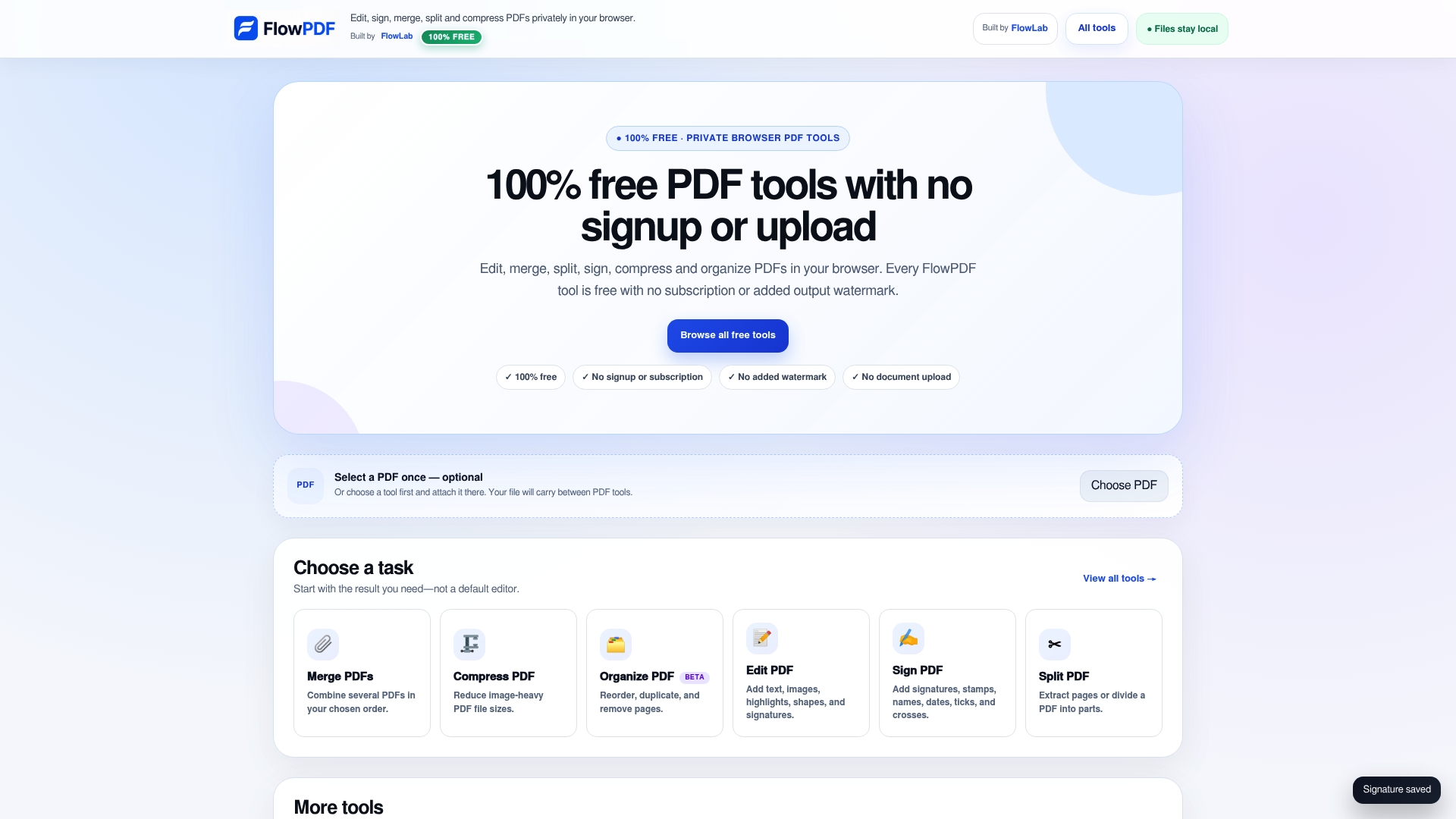
Start with the edit or compress tool on a real document you already have, then try merge on two files to see how the interface handles a second task in the same session. Browse the full tool list if you need something beyond those three, since every feature runs the same way, locally and free.
FAQ
What is the lightest PDF editor available?
The lightest options are typically annotation-only apps or small portable executables, since they skip the rendering engines full editors need for layout changes. Benchmarking across lightweight Windows tools found that annotation-focused apps carry far lower RAM footprints than full editors, according to iGeeksBlog's testing.
What is the best free, lightweight PDF reader?
A browser-local tool is a strong starting point for most readers, since it needs no installation and opens files instantly without uploading them anywhere. Portable, no-install executables are a close alternative when you need to carry the tool between machines on a USB drive.
Is Foxit better than Adobe?
Both are full-featured commercial editors built for different priorities, Foxit generally emphasizes a smaller install and faster launch, while Adobe emphasizes depth of features. Neither fits the lightweight category this article focuses on, so the better fit depends on whether your bottleneck is resource use or feature depth.
What is the best 100% free PDF editor?
This tool is offered completely free, with every tool, including edit, merge, split, and compress, available with no signup, no watermark, and no file upload required. Among open-source desktop alternatives, LibreOffice Draw also offers genuine content editing at no cost.