
The simplest way to edit a PDF without a watermark is to use a privacy-first, no-upload editor such as FlowPDF, which processes files locally in your browser and never adds a watermark to your export. There is no signup, no subscription, and no server involved. The only thing to watch is that free tools like this usually set limits on file size or page count per task.
TL;DR:
- Using a local, no-upload PDF editor like FlowPDF prevents watermark addition and preserves your privacy by processing files entirely in your browser.
- FlowPDF offers core features such as text editing, page organization, compression, redaction, and signing, all without watermarking on export, but with size and page limits depending on your device.
- To avoid watermarks, check embedded fonts and flatten form fields before exporting, and verify the final file for any hidden marks or layout issues.
- For sensitive documents, redact information and remove metadata within the browser to prevent leaks, ensuring the file remains private without server involvement.
- Large files or scanned images may require splitting or higher-resolution scans, as in-browser editing performance depends on local device memory and the PDF's text layer.
Table of Contents
- What FlowPDF does and why it skips watermarks
- Step-by-step: edit and export a PDF without a watermark
- Alternatives if a browser-based editor isn't the right fit
- Privacy, free-tier limits, and handling sensitive documents
- Quick QA: confirm your PDF has no watermark and prints cleanly
- Why watermark-free, private editing matters more than it seems
- Get a clean PDF without a watermark, starting now
- Sources and resources worth bookmarking
- FAQ
What FlowPDF does and why it skips watermarks
FlowPDF is a browser-based PDF toolkit that keeps your document on your device the entire time you work on it. Nothing gets uploaded to a server, so there is no step in the process where a watermark could be injected on export, which is how some online editors nudge you toward a paid plan.
The toolkit covers the tasks most people actually need:
- Edit text, images, and annotations directly on the page
- Merge, split, organize, rotate, and crop pages
- Compress files to reduce size without losing readability
- Redact sensitive content permanently before sharing
- Sign documents and export a clean, finished file
All of this is described on the free PDF tools overview, which states the no-upload, no-watermark policy plainly rather than burying it in fine print.
FlowPDF advertises all core PDF features as free with no watermark added on export, according to its own product pages. That claim matters because many "free" editors quietly cap your options until you pay, often by stamping a watermark across your export.
Free does not mean unlimited. Expect practical limits on file size and how many pages you can process in one pass, since local, in-browser processing depends on your device's own memory rather than a server farm. For most contracts, forms, and reports, this is not a problem. For a 300-page scanned archive, you may need to split the job into smaller batches.
Step-by-step: edit and export a PDF without a watermark
Editing cleanly is less about finding the right software and more about following a process that avoids the usual traps.
- Open your file directly in the editor rather than emailing it to a service or uploading it to a cloud drive first.
- Make your edits: adjust text, drop in images, add annotations, or fill out form fields.
- Check font embedding before you export. A missing embedded font can make text look like it has a faint overlay, which some users mistake for a watermark.
- Flatten form fields if the document no longer needs to be interactive. This locks your edits in place and avoids rendering oddities in some PDF viewers.
- Reorder or remove pages as needed using an organize tool before your final export.
- Export and open the result immediately to confirm it matches what you expect.
Pro Tip: If a scanned PDF looks blurry after editing, the original scan resolution is usually the cause, not the editor; re-scan at a higher DPI if the source allows it.
Large files are the most common snag. If your editor stalls or slows down, try splitting the document first and editing each piece separately. Scanned PDFs without embedded text can also behave unpredictably when you try to select or edit text that is really just an image, so check whether your file has a real text layer before you start.
Your quick checklist before you call the job done: the file opens without errors, no stray marks appear across pages, fonts render correctly, and the file size is reasonable given the content.
Alternatives if a browser-based editor isn't the right fit
A no-upload browser tool fits most everyday editing, but a few situations call for something else.
- Local desktop apps work offline, handle very large files well, and suit anyone editing PDFs regularly without an internet connection, though they require installation and sometimes a license fee.
- Paid cloud editors offer advanced features like OCR on scanned archives or team collaboration, but they require uploading your file to a server and usually run on a subscription.
- Browser extensions and embedded widgets, the kind distributed through the Chrome Web Store or as WordPress plugins, are convenient for quick one-off edits embedded in another site, but they often request broad permissions and may upload your file behind the scenes.
If you are editing a contract with client names and figures, a no-upload tool is the safer default. If you are OCR-scanning hundreds of old paper records, a dedicated desktop app or a paid cloud service built for that volume will likely save you more time.
Privacy, free-tier limits, and handling sensitive documents
Local processing means your PDF never leaves your device, which closes off an entire category of risk: a server breach, a misconfigured storage bucket, or a vendor quietly logging your uploads. Server-side editors, by contrast, need to receive your file before they can touch it, even if they delete it afterward.
Typical free-tier limits to expect from in-browser tools include a maximum file size, a page count ceiling, and sometimes a cap on how many tasks you can run per hour. If you hit one of these, compressing the file first or splitting it into smaller sections usually clears the way.
For anything genuinely sensitive, like medical records, legal filings, or financial statements, combine two habits:
- Redact rather than just black out text, since a cosmetic cover can sometimes still be copied or revealed
- Strip unnecessary metadata, such as author names or edit history, before sharing the final file
FlowPDF's redaction tool removes sensitive content permanently within the browser rather than just visually hiding it. Document metadata and provenance carry real weight in formal or legal contexts, a point explored in detail by a digital forensics expert's writing on metadata authentication.
Pro Tip: Before sending a PDF to a client or counterparty, open the file properties panel and clear the author and company fields if they reveal more than you intend.
Quick QA: confirm your PDF has no watermark and prints cleanly
A few minutes of checking after export saves you from sending out a flawed file.
- Scroll through every page visually, since a watermark sometimes only appears on certain pages rather than the whole document.
- Use the search function in your PDF viewer to look for stray text objects that might be a hidden or faint watermark layer.
- Open the document properties or metadata panel to check for leftover tool names or edit history you did not intend to include.
- Run a print preview to catch layout shifts, cropped margins, or unexpected scaling before you print or send the file.
- Compare the exported file size against the original. A sudden jump can signal embedded fonts or images you did not intend to keep.
- If you do find a watermark, re-export using a tool with an explicit no-watermark policy or remove it locally rather than resending the flawed copy.
Why watermark-free, private editing matters more than it seems
Most people only think about watermarks when one shows up uninvited on a document they need to send to a client, a landlord, or a court. At that point, it is too late to pick a better tool. The habit worth building is choosing a no-upload editor before you start, not after you are stuck.
Contracts, signed agreements, and medical or financial paperwork are the clearest cases where a stray watermark or an uploaded copy sitting on someone else's server is not acceptable. That said, not every job fits a free, in-browser tool. Large-scale OCR projects or team review workflows with version tracking often still call for paid software built for that scale.
— Ronald Ang
Get a clean PDF without a watermark, starting now
FlowPDF edits your document locally in the browser, so your file never touches a server and no watermark ever appears on your export. There is no account to create and no plan to upgrade to later.
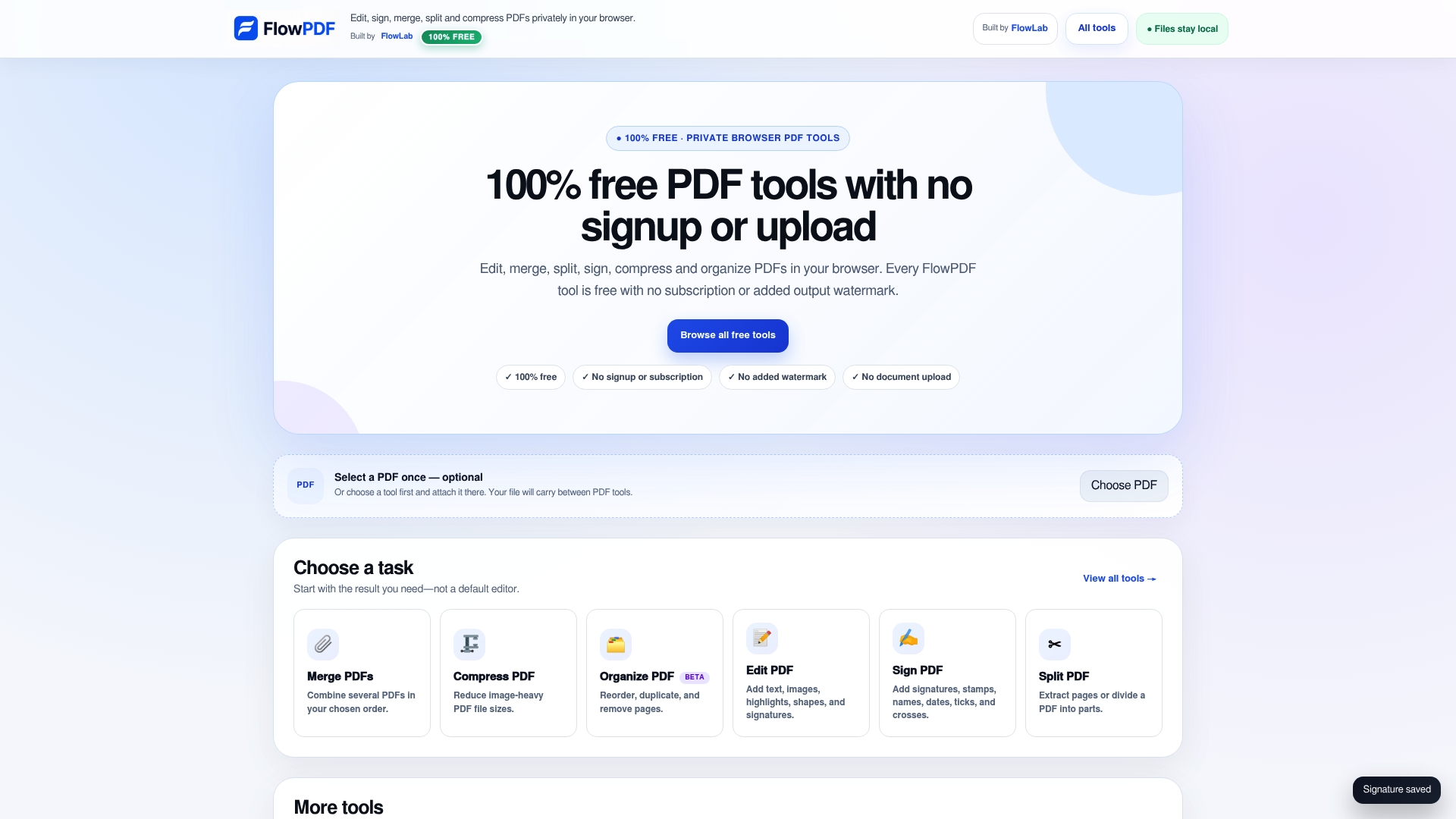
Start with whichever task matches what is in front of you:
- Edit text, images, or form fields on the edit PDF page
- Combine files with merge PDF or split a large one apart
Open your file, make the changes you need, and export. That is the whole process.
Sources and resources worth bookmarking
The claims above draw on FlowPDF's own product pages for its free toolset, redaction feature, and watermark tool, each of which documents the no-upload, no-watermark approach directly.
For readers handling documents in a legal or compliance context, a digital forensics expert's take on metadata authentication is worth a read before you finalize sensitive files. If your workflow involves sending documents by email rather than editing them locally, this guide to secure document transmission covers risks that apply just as much to PDFs as to other file types.

FAQ
How can I remove a watermark from a PDF file for free?
Open the file in a local, in-browser editor and use its watermark removal option rather than a service that requires uploading the file. FlowPDF's watermark tool handles this entirely on your device, with no file leaving your browser.
Which PDF editor is 100% free?
FlowPDF offers its full set of editing, merging, compressing, and redaction tools for free with no signup or subscription required, according to its own product pages. Other editors may advertise a free tier but limit features or add a watermark until you upgrade.
Can Notepad++ edit PDF files?
No, Notepad++ is a plain text editor and cannot open or edit PDF files, since PDFs store formatted layout data rather than plain text. You need a dedicated PDF editor, whether a browser-based tool or a desktop application, to make changes to a PDF.
How can I watermark a PDF for free?
A local PDF editor with a built-in watermark feature lets you add text or an image watermark without uploading your file anywhere. FlowPDF's watermark tool applies the watermark directly in your browser and lets you export the result immediately.