
Yes, you can fill, sign, and download most PDF forms directly in your browser. If the form has interactive fields, click and type. If it does not, add a text overlay or run OCR. For sensitive documents, choose a tool that processes files locally, like FlowPDF, rather than one that uploads your file to a server.
TL;DR:
- Browsers like Chrome support filling, signing, and OCR processing for standard PDFs directly on the device, avoiding data transfer risks.
- When handling sensitive documents, use tools that process files locally without requiring sign-ins or uploading to protect personal information.
- OCR and manual overlay techniques can make scanned or flattened PDFs fillable, but may not support automated data extraction unless converted to interactive fields.
- For official or legal forms, verify if a certificate-backed digital signature is required, as simple signatures may not suffice.
- Troubleshooting common issues involves checking for XFA technology, reopening files in compatible viewers, and always keeping an editable copy before finalizing.
Table of Contents
- Step-by-step: open, fill, sign, and download a PDF entirely in the browser
- Try your browser first: what Chrome and other browsers can do
- How to choose a browser-based PDF editor that protects your privacy
- Scanned or flattened PDFs: OCR and overlay techniques to make them fillable
- Signing explained: typed signatures versus certificate-backed digital signatures
- Privacy-first note: why local processing matters
- Troubleshooting: fields not clickable, missing text, and signature problems
- Publisher perspective on browser-first PDF workflows
- FlowPDF quick-start: fill and sign PDFs without uploading
- FAQ
- Sources
Step-by-step: open, fill, sign, and download a PDF entirely in the browser
You do not need desktop software to finish a form today. The process is short and works the same way across most free browser tools.
- Open or drag the PDF into a browser tab or the tool's upload area.
- Click into any interactive fields and type your answers directly.
- If fields are missing, add text boxes over the blank spaces instead.
- Insert a signature by typing your name, drawing it, or uploading an image, then add the date or check marks where needed.
- Save an editable copy first, then flatten or export the final version for submission.
Most tools accept standard PDF files of typical sizes without trouble. Large scanned documents may take longer to load, so check file size before you start. On mobile, use your browser's "desktop site" option if a tool looks cramped or unresponsive on a phone screen.
Try your browser first: what Chrome and other browsers can do
Before reaching for a separate tool, check what your browser already offers. Chrome's built-in PDF viewer supports filling, signing, annotating, and on-device OCR for scanned PDFs, which means text recognition happens on your device rather than on a remote server.
To use it, open the PDF in a Chrome tab, click into any fillable fields, and use the annotation toolbar to draw a signature or add notes. Save your work when you are done.
- Chrome handles standard AcroForm fields well, including text boxes and checkboxes.
- Some complex or older forms use XFA technology, which Chrome's viewer may not expose correctly.
- If fields look unresponsive, try the issuer's recommended viewer instead.
Chrome's PDF viewer performs OCR and signing on the device, which the browser's own help documentation confirms, meaning your scanned file is not sent elsewhere for text recognition.
How to choose a browser-based PDF editor that protects your privacy
Not every free PDF tool treats your documents the same way. A few quick checks tell you whether a tool is worth trusting with a sensitive form.
- Look for local processing, meaning your file never leaves your device.
- Avoid tools that require sign-in or an account just to fill a form.
- Check for watermarks added to your finished document.
- Confirm the tool supports typed, drawn, or image-based signatures.
- Verify it can handle scanned pages through OCR or text overlays.
Cloud upload is fine for a low-risk form, like an event registration or a simple survey. It is not fine for anything carrying identity numbers, financial details, or medical information. Before you commit to a tool, skim its privacy page or processing notes, or simply test it with a harmless file and watch whether a network request fires when you open it.
Pro Tip: Open your browser's developer tools and check the network tab while uploading a test file. If you see your file name in an outgoing request, the tool is sending it somewhere.

Scanned or flattened PDFs: OCR and overlay techniques to make them fillable
A scanned form is just an image of a page, not a real form. Making it usable takes one of two approaches.
- Run on-device OCR if your browser or tool offers it, which makes the text searchable but does not create clickable fields.
- Add text boxes manually and align them over each blank line, checking placement by zooming in before you finalize.
- If the issuer specifically requires a true fillable form rather than a visual overlay, ask them for the original fillable version or convert the scan into interactive fields using a PDF editor built for that purpose.
Overlay text looks right on screen but will not behave like a real form field if the recipient tries to extract data from it automatically. When that distinction matters, ask first.
Signing explained: typed signatures versus certificate-backed digital signatures
Most everyday forms accept a simple signature. Contracts, government filings, and some financial documents often need more.
- A typed name, drawn signature, uploaded image, or checkbox consent covers most routine paperwork.
- Certificate-backed digital signatures embed cryptographic data that a recipient's software can verify independently.
- The required type depends entirely on who is receiving the document and what they need it for.
Singapore's government guidance on e-signatures draws a clear line between Ordinary Electronic Signatures and Secure Electronic Signatures, and notes that higher-assurance workflows often call for certificate-backed methods such as Singpass-based digital signing. The distinction between a simple signature and a certificate-backed one is not cosmetic. Singpass Sign, for example, embeds a cryptographic hash that standard PDF readers can verify, which a drawn signature cannot replicate. Before you submit anything official, confirm with the recipient which type they require.
Privacy-first note: why local processing matters
When a PDF carries an ID number, a bank detail, or a medical history, where that file travels matters as much as how it gets filled out.
- Local processing means your document is read and edited on your own device, never sent to a server.
- This matters most for identity documents, financial forms, and medical paperwork, where a single upload mistake creates lasting exposure.
- Some PDF tools process files locally: no uploads, no signup, and no watermarks added to the finished PDF.
- You can verify any tool's claims by checking its documentation or running a test file and watching for outgoing network activity.
If you want a broader look at how document and device security connects to physical data destruction, this secure IT disposal guide covers the eco-safe side of retiring old hardware that once held sensitive files.
Troubleshooting: fields not clickable, missing text, and signature problems
A few recurring issues account for most of the frustration with browser-based form filling.
- If fields will not respond to clicks, the form may use XFA technology rather than standard AcroForm widgets. Ask the issuer for a standard version or use their recommended viewer.
- If your typed entries vanish after saving, reopen the file in a different reader or re-export it, since missing appearance data can make saved entries invisible without deleting them.
- Always keep an editable copy of your work before flattening the file. Flatten only the version you plan to submit.
Publisher perspective on browser-first PDF workflows
Browser-first filling works well for quick forms, agreements between people who already trust each other, and routine paperwork that does not carry legal weight. It is not the right call for high-assurance legal filings, where the recipient's own rules decide the signature method, not your convenience. Keep an editable copy of everything, and open your final file in the recipient's preferred viewer before you send it.
— Ronald Ang
FlowPDF quick-start: fill and sign PDFs without uploading
Some tools let you fill, edit, and sign PDF forms entirely in your browser, with no uploads, no signup, and no watermarks added to the finished file. It handles typed form fields, text overlays for scanned pages, and signatures you type, draw, or insert as an image.
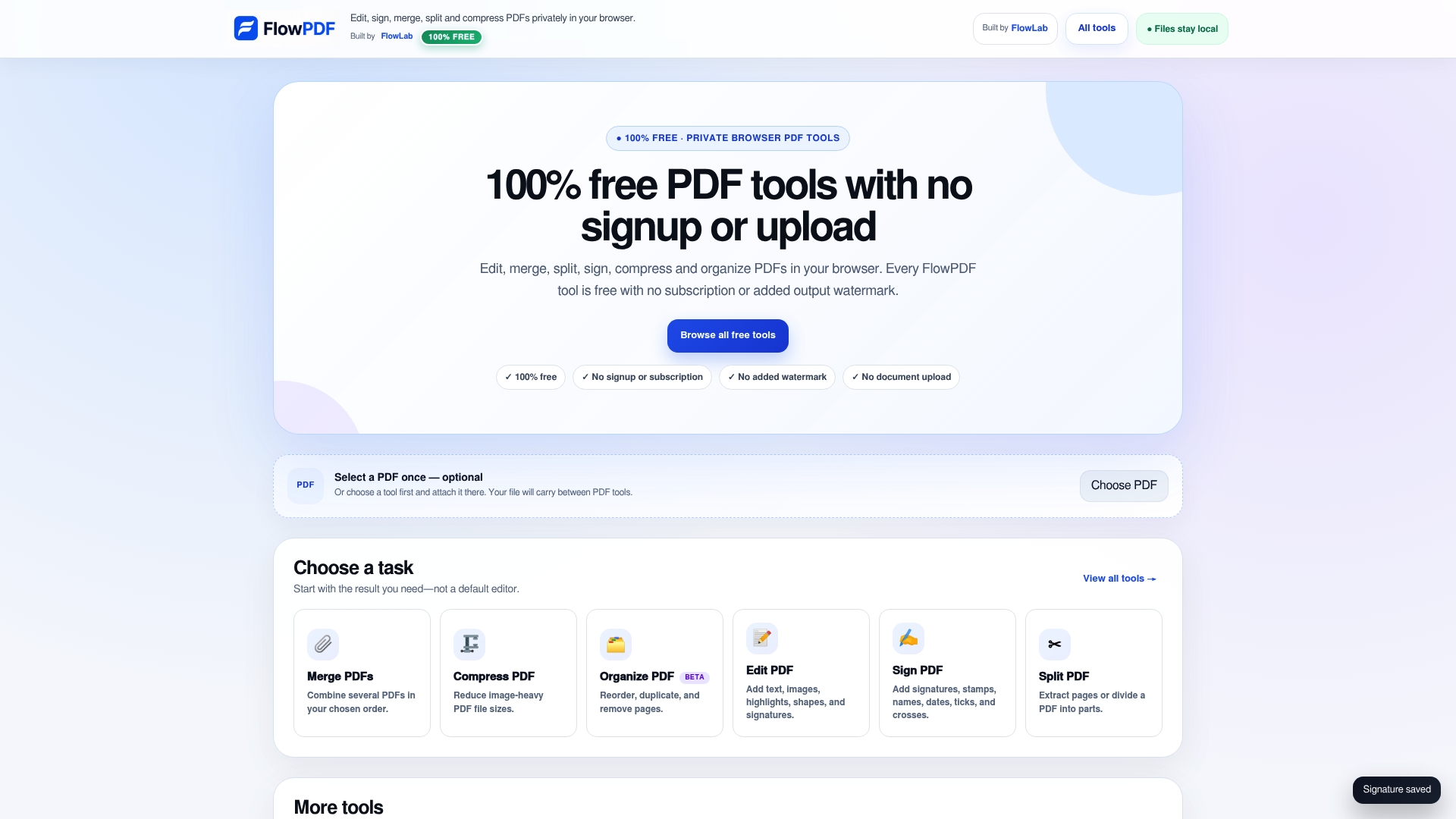
- Start with the form filling tool to complete interactive or overlay fields.
- Use the signing tool to add your signature before export.
- Browse the full free toolset if your document needs merging, compressing, or redacting first.
Open your PDF at Flowpdf and finish your form in the time it takes to read this sentence twice.
FAQ
Can I fill out a PDF form in Chrome?
Yes, Chrome's built-in PDF viewer lets you click into standard form fields and type directly, and it can also run on-device OCR on scanned pages. If a form uses older XFA technology, Chrome may not expose the fields, and you will need the issuer's recommended viewer instead.
How can I fill out a PDF form online?
Open the file in your browser's native viewer first, or use a browser-based tool like FlowPDF that fills, edits, and signs without uploading your document anywhere. Type into existing fields, or add text boxes where no fields exist, then export your finished copy.
How can I make a PDF form fillable online?
If the original file has no interactive fields, add text boxes positioned over each blank line using a browser-based editor. For a true fillable form rather than a visual overlay, ask the issuer for the original version or convert the scan using a tool designed to create interactive fields.
Why can't I fill out a PDF form on my computer?
The form may use XFA, a form technology that many standard viewers cannot read correctly, which makes fields appear unresponsive. Try the issuer's suggested viewer, or add a text overlay in a browser-based editor as a practical workaround.
Sources
These sources back the signing and browser-capability guidance in this article, covering Chrome's PDF tools and electronic signature standards.
- Manage PDFs in Chrome - Computer - Google Chrome Help
- E-Signatures | Singapore Government Developer Portal
- How do our digital signatures work — Sign with Singpass