
To rotate PDF pages, open an in-browser rotate tool, pick the pages, choose a rotation angle, and download the file. The tool should write the rotation into the PDF's page metadata so it sticks in every viewer. You can turn one page, a selection or the whole document. We built a free rotate tool that works this way and never uploads your file.
TL;DR:
- For a uniform scan, rotate every page; for a mixed document, select only misoriented pages, or correct a few exceptions after rotating most pages.
- Choose a tool that writes page rotation into PDF metadata, then reopen the download in another reader; this preserves scanned image quality.
- Rotate pages before adding notes or completing forms; existing annotations usually follow the page, but signature fields and checkboxes may remain misaligned.
- Turn a page 90 degrees right when its top faces left, 90 degrees left when its top faces right, and 180 degrees when upside down.
Table of Contents
- How do you rotate selected pages or the whole PDF in your browser?
- How do you rotate only the pages that need it?
- Why does permanent rotation matter, and how do you verify it?
- What if the rotation does not look right?
- Why is in-browser rotation the practical choice?
- How does rotation affect annotations and form fields?
- When should you rotate clockwise and when counterclockwise?
- Our take: rotate in the browser, and do it before anything else
- Rotate your PDF now, free and without an upload
- FAQ
- Sources
How do you rotate selected pages or the whole PDF in your browser?
You do not need to install anything. Our Rotate PDF tool runs inside your browser tab, and the steps are the same whatever the document length.
- Open the rotate tool, then drag your PDF onto the page or choose the file from your device. The tool lets you work with your PDF pages.
- Select the pages you want to turn.
- Choose a rotation for the pages.
- Check the pages you changed before applying the rotation.
- Apply the rotation and download the file.
A few details make the process smoother:
- You can rotate a page more than once.
- You can undo a mistake by rotating the page back before you download.
- Nothing leaves your device, so a scanned contract or ID copy stays private.
If you only need to fix one page, our walkthrough on how to rotate a single PDF page in your browser is a shorter read. On a Mac, there is also a guide to rotating PDFs on Mac that pairs Preview with a private browser fix.
You can use a browser-based tool to rotate a PDF without downloading an app.
How do you rotate only the pages that need it?
Scanned documents rarely arrive with one consistent orientation. A stack of portrait pages may hide a few landscape charts, or the reverse. Touching every page by hand wastes time, so use selection patterns and presets.
Pick the pages you want to rotate, or select all if the whole document needs turning.
Use rotate all for a uniform scan, like a book scanned entirely on its side. For a mixed file, select only the pages that need turning. In that case, selecting all would turn the good pages sideways too.
Pro Tip: Scan the thumbnail grid first and count how many pages are wrong. If it is most of them, rotate all and then fix the exceptions. If it is a few, select just those.

Once the orientation is right, you may want to reorder or delete pages too. Our Organize PDF tool handles that in the same private way. If the file needs to be broken into parts afterward, PerPageFax offers a split tool for pulling pages out of a PDF.
Why does permanent rotation matter, and how do you verify it?

Some viewers only flip the page on screen. Close the file and the page is sideways again, or your colleague opens it and sees the original problem. A permanent rotation fixes that by changing the file, not the view.
Every PDF page can store a /Rotate entry with a value of 0, 90, 180 or 270. When a tool updates that entry, the change travels with the document. Developer guidance on pdf-lib shows the library updating this rotation metadata rather than redrawing the page, which also means scanned images are not re-encoded and keep their quality.
The PDF standard itself, ISO 32000-2:2020 (PDF 2.0), defines how PDF processors read and modify PDF files. That shared definition is why a rotation written into page metadata behaves consistently across compliant viewers. The Library of Congress also describes PDF as a standards-based container.
Before you trust any tool, look for wording like "saves rotation permanently" or "writes rotation into the PDF." Then verify the result yourself: reopen the downloaded file in a different PDF reader, or open the print preview. If the orientation matches in both, the rotation is real.
What if the rotation does not look right?
Most problems have a quick fix. Work through these before you start over.
- Thumbnails do not match the saved file: refresh the preview or reopen the downloaded PDF to confirm what was actually saved.
- Odd angles after several turns: rotation should be tracked relative to the current angle and normalized with % 360, as the pdf-lib walkthrough explains. Four right turns should land you back at 0°.
- Password-protected file: unlock it first. Our Unlock PDF tool is available as a separate step.
- Large files: thumbnails take time to render on a long document. Once the pages are ready, you can apply the rotation.
- Interactive forms: form fields may not turn with the page content, so test the saved file before you send it.
Pro Tip: After downloading, scroll through the whole file in a second reader. This can catch a page you missed.
Why is in-browser rotation the practical choice?
For sensitive or large scanned documents, local rotation is the sensible default. Your file never travels to a server, so a signed agreement or medical scan stays on your machine. It is also quick, since no upload or download queue sits in the middle.
Metadata rotation has another benefit that people overlook: image quality. Because the page is not re-rasterized, a sharp scan stays sharp. That makes this approach a good fit for fixing sideways scans, turning a few odd pages inside a long scan, or preparing a document for printing.
How does rotation affect annotations and form fields?
Rotation changes how a page is displayed, so the things attached to that page generally follow the display. Highlights, comments and stamps usually turn along with the page and stay anchored to the text they mark. That is the behavior you want when you fix a sideways scan that already has notes on it.
Form fields are less predictable. Depending on how the form was built, a field may stay in its original orientation while the page content turns. The result can be a text box that sits oddly or is hard to click. Signature fields and checkboxes are the ones to check first.
A simple routine avoids trouble:
- Rotate the pages before you add annotations or fill in a form whenever you can.
- If the file already has annotations, rotate and then scroll through every marked page.
- For interactive forms, click into a few fields to confirm they still accept input.
- Keep the original file until you have checked the rotated copy.
Rotating first and annotating second is the cleanest order. If you plan to fill the form afterward, our Edit PDF tool works on the corrected file, so you are filling in a page that already reads the right way up.
When should you rotate clockwise and when counterclockwise?
Both directions can end in the same place, so the choice is mostly about speed. A page that is turned a quarter to the right needs a quarter turn back to the left. A page that is upside down needs 180°, and the direction does not matter at all.
Think of the result you need:
- 90° clockwise (right): the top of the page currently faces left, so turn it right to bring the text upright.
- 90° counterclockwise (left): the top of the page currently faces right, so turn it left.
- 180°: the page is upside down. Either direction works.
Here is a quick trick. Tilt your head toward the way the text is leaning. If the text reads from bottom to top, rotate the page right. If it reads from top to bottom, rotate it left.
Under the hood, the three common turns map to 90°, 180° and 270° in the file. A left turn of 90° is stored as 270°, because the angle is normalized using 360°. You will never need to do that math yourself, but it explains why the saved angle may differ from the button you pressed. If a page looks wrong after saving, the fix is to turn it back the other way, not to start the whole file over.
Our take: rotate in the browser, and do it before anything else
The usual advice is to open the PDF in whatever app is closest and spin the page. That works for a quick look, but it often fixes only the view, and the file stays wrong for everyone else. What matters is whether the rotation was written into the document. Check that first, then worry about convenience.
The thing most guides underrate is privacy. Many online rotators upload your file, rotate it on a server and send it back, which is a lot of travel for a task that only changes one number per page. Local, metadata-only rotation avoids an upload, preserves image quality, and keeps the file with you.
My advice: rotate first, annotate second, and always reopen the saved file in a second reader before you send it.
— Ronald Ang
Rotate your PDF now, free and without an upload
We made rotating pages as short a task as possible, and you can start it right now. Our rotate tool turns pages inside your browser and saves the rotation into the file, so it holds up in any viewer.
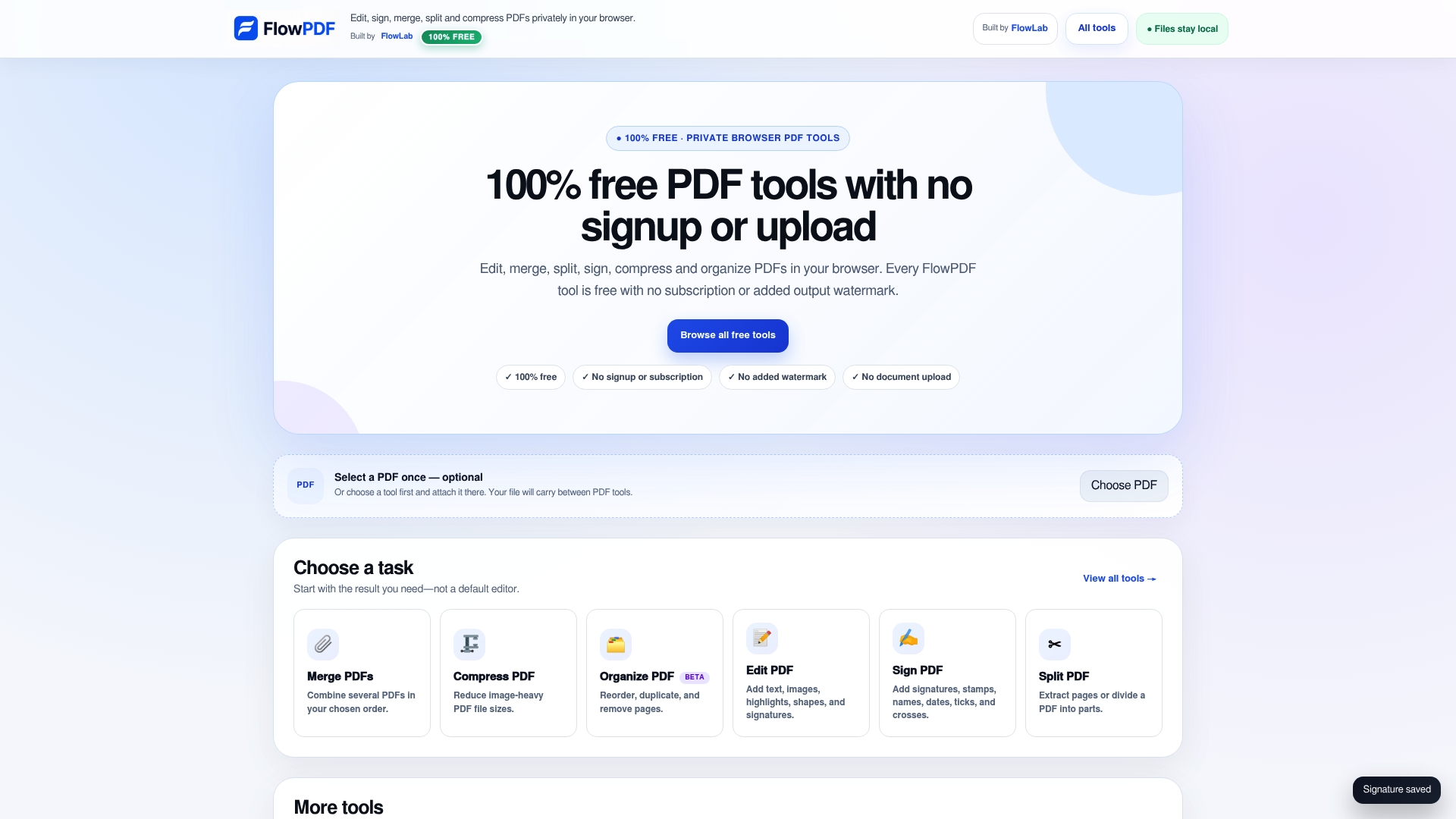
- Rotate selected pages or the entire document
- Use orientation presets for landscape-only or portrait-only pages
- No uploads, no watermarks and no signup required
- Free to use, with no cost at any step
Open the Rotate PDF tool to fix your file, or browse all our free PDF tools if you have more to do.
FAQ
How do I edit a PDF to rotate pages?
Open a browser-based rotate tool, select the pages you want to change, and choose a rotation angle. Then download the file. Pick a tool that writes the rotation into the PDF so it stays correct in every viewer, as the PDF 2.0 standard describes for page-level changes.
Can I rotate PDF pages on my phone?
Yes. A browser-based tool works the same on iPhone and Android, with no app needed. Open the tool, choose your file, tap the pages to rotate and download the result.
Does rotating a PDF reduce its quality?
Not when the rotation is stored as page metadata. The page is not redrawn, so scanned images keep their original sharpness. You can confirm this by comparing the file before and after.
Why does my rotated PDF look sideways again in another viewer?
You probably used a view-only flip, which changes the display but not the file. Redo the rotation with a tool that saves it permanently into the PDF. Then reopen the new file in a second reader to check.
Sources
- Loc
- ISO 32000-2:2020 - Document management — Portable document format — Part 2: PDF 2.0
- Rotating PDF Pages in the Browser with pdf-lib — Per-Page Rotation, Thumbnail Grid, and Cumulative Angle Tracking - DEV Community