
If you need a Foxit replacement, we recommend starting with FlowPDF for most everyday edits because it processes files locally in your browser, costs nothing, and never adds a watermark. Beyond that, your options include premium desktop suites, lightweight offline readers, browser-based freemium editors, and cloud workflow platforms. People switch away from Foxit for privacy, pricing, or feature reasons, and the right category depends on which of those matters most to you.
TL;DR:
- Browser based freemium editors may upload files and cap pages or add watermarks, so check deletion terms and export limits before using sensitive documents.
- Choose a premium desktop suite for certificate backed signatures, deep redaction audits, or enterprise workflows, and confirm in writing whether files stay local.
- For offline reading and markup, PDF Rider is a roughly 5.5 MB portable option that also signs, fills forms, and compresses files without an installer.
- Cloud workflow platforms charge per seat and store files online; verify their audit logs record who viewed, edited, or approved each document before subscribing.
- When testing redaction, confirm the text beneath the black mark is removed; a visual cover alone can leave sensitive content copyable.
Table of Contents
- FlowPDF vs. Alternative Categories at a Glance
- Finding the Right Fit: FlowPDF and Every Alternative Category Explained
- Core Features to Test Before You Commit
- How to Choose the Right Foxit Alternative
- How We Tested and What Trust Signals Matter
- Switching From Foxit: What the Migration Actually Takes
- What a Foxit Replacement Really Costs
- Comparing Support Quality Across Alternatives
- When FlowPDF Is the Right Call, and When It Isn't
- FlowPDF: Try It Now, Starting With One Real File
- FAQ
- Sources
FlowPDF vs. Alternative Categories at a Glance
Before you commit to any tool, it helps to see how the main categories stack up side by side. We built this table around the factors that matter most when you're moving away from Foxit: where your file actually gets processed, what the free tier really gives you, and what each category is built to handle.
| Option | Best for | Platforms supported | Pricing model | Privacy / local processing | Free tier and watermark policy | Standout feature |
|---|---|---|---|---|---|---|
| FlowPDF | Privacy-conscious users needing quick edits, merges, and splits | Browser (any OS) | Free | Fully local, no upload | Free, no watermark | In-browser processing with no file upload |
| Premium desktop suites | Advanced production, certificate-backed signatures, enterprise rollouts | Windows, macOS | Subscription or perpetual license | Varies; many process locally but sync to cloud accounts | Free trials often limited by time or feature | Deep OCR, redaction, and form-building tools |
| Lightweight offline readers | Simple reading, annotation, and basic markup with minimal overhead | Windows, sometimes macOS and Linux | Free or one-time low cost | Local by design, often no account needed | Free with few or no restrictions | Small install size and fast startup |
| Browser-based freemium editors | Occasional edits without installing software | Browser (any OS) | Free tier plus paid upgrade | Often upload-based; check each vendor's policy | Free tier frequently adds watermarks or page limits | Fast setup with no download |
| Cloud workflow platforms | Teams needing shared review, approval chains, and integrations | Browser, desktop, mobile | Per-seat subscription | Upload-based with cloud storage | Free tier usually capped on documents or storage | Built-in collaboration and audit trails |
Pricing and feature sets change often, so confirm current terms directly with each vendor before you switch. A quick way to check availability in your market: open the vendor's own pricing or app-store page and look for your country listed under supported regions or payment methods.
Finding the Right Fit: FlowPDF and Every Alternative Category Explained
Replacing Foxit usually comes down to matching your workflow to the right category rather than picking a single "best" app. Here's how FlowPDF and each alternative group actually work, who they fit, and how to verify a candidate before you rely on it.
FlowPDF: edit, merge, and sign without uploading anything
FlowPDF runs entirely in your browser, which means your PDF never leaves your device during editing, merging, splitting, or compressing. We built it this way because document privacy shouldn't depend on trusting a server you can't see.
- You get the full toolkit (edit, merge, split, compress, organize, rotate, crop, watermark, sign, protect, unlock, redact, fill forms, compare, scan, and more) without creating an account.
- Every feature stays free, and we never add a watermark to your exported file.
- It suits freelancers editing contracts, students assembling reports, and small teams who need fast PDF work without a subscription.
Quick verification step: open any non-sensitive PDF in the Edit PDF tool, make a small change, export it, and confirm the output carries no watermark and no visible upload progress bar.
Premium desktop suites: built for complex, high-volume production
This category covers full-featured desktop applications designed for heavy PDF production: contract redlining, advanced redaction, certificate-backed digital signatures, and enterprise document management. If your organization already standardizes on Microsoft 365 or a specific compliance stack, a premium suite often integrates more tightly with existing approval workflows.
- Typical pricing runs on an annual subscription per seat, sometimes with a perpetual-license option for older versions.
- Many of these suites process files locally once installed, but features like cloud sign-off or shared review often route documents through the vendor's servers.
- Procurement teams handling Controlled Unclassified Information or export-controlled files should weigh vendor ownership structure as part of due diligence; Casrai's guidance on vendor ownership considerations is a useful starting point, and its research on Foxit's ownership notes that institutions sometimes prefer US-headquartered vendors when ownership factors into procurement policy, naming Adobe Acrobat as the most direct functional comparison for many features.
- Best suited to legal teams, finance departments, and enterprises that need certificate-backed signatures or deep redaction audit trails.
Quick verification step: during any trial, ask the vendor directly whether document processing happens locally or on their servers, and get that answer in writing before you roll the tool out to a team.
Lightweight offline readers: minimal footprint, maximum control
If all you need is to open, annotate, and occasionally sign a PDF without installing a large application, a lightweight offline reader covers that job without the overhead of a full editing suite. These tools tend to be small, fast, and free, with no account requirement.
- An open-source example, PDF Rider, ships as a roughly 5.5 MB portable executable that reads, annotates, signs, fills forms, and compresses files without an installer, works offline, and keeps everything local.
- Drawboard PDF, available through the Microsoft Store, focuses on markup and annotation rather than full document production.
- Pricing is usually free or a small one-time fee, with no subscription attached.
- These readers fit students, reviewers, and anyone who mostly marks up PDFs rather than rebuilding them.
Quick verification step: disconnect your device from the internet, open a sample file, and confirm the reader still opens and saves annotations without an error or a prompt to reconnect.
Browser-based freemium editors: fast setup, watch the fine print
This category includes browser tools that let you upload a PDF, make a quick edit, and download the result, often with a free tier that caps page counts or adds a watermark once you hit a limit. They're convenient for a single quick task, but the convenience usually comes from uploading your file to the vendor's servers rather than processing it on your device.
- Typical pricing follows a freemium model: a handful of free operations, then a monthly or annual plan to remove limits.
- Because files are uploaded, privacy depends entirely on the vendor's retention and deletion policy, which varies by provider and is worth reading before you send anything sensitive.
- Best for occasional, low-stakes tasks where speed matters more than keeping the file off a server.
Quick verification step: upload a test file, export it, and check the output for a watermark stamp or a cropped preview, since many free tiers restrict exactly those two things.
Cloud workflow platforms: built for teams, not solo edits
Cloud platforms add shared review links, approval chains, and integrations with storage services like Google Drive or SharePoint. They solve a different problem than simple editing: coordinating a document across multiple people rather than making a single change.
- Pricing is almost always per-seat, which can make sense for a team but adds up quickly for a solo user.
- Files live on the platform's cloud storage by design, so local processing isn't the selling point here, collaboration is.
- These fit teams that need audit trails, version history, and sign-off tracking across departments.
Quick verification step: check whether the platform's audit log shows exactly who viewed, edited, or approved a document, since that trail is usually the entire reason to pay for this category.
If secure handoff between people matters as much as the editing itself, it's worth reading a partner guide on secure document sharing for professionals before you settle on a workflow, since the sharing step is often where privacy actually breaks down.
Core Features to Test Before You Commit
Most people leaving Foxit care about the same handful of features: editing text, redacting sensitive content, running OCR on scanned pages, signing, filling forms, merging or splitting files, compressing, and extracting content. Testing each one directly, rather than trusting a feature list, is the only way to know a candidate actually works for your files.
- Edit text: open a PDF with a paragraph of body text and confirm you can change a word without the layout shifting.
- Redact: black out a line of text and confirm the underlying text is actually removed, not just visually covered, since a cosmetic box over text can still be copied out. A local redaction workflow is worth reading before you redact anything sensitive.
- OCR: run a scanned page through the tool and check whether the output text is searchable and accurate.
- Sign: add a signature field and confirm the signed file opens correctly in a different PDF reader.
- Fill forms: open a fillable form and confirm checkboxes and text fields save correctly on export.
- Merge and split: combine two files, then split them back apart, and confirm page order survives both operations.
- Compress: compress a large file and compare the output size against the original to see whether quality holds up.
- Extract: pull text or specific pages out of a document and confirm formatting survives the extraction.
Privacy implications matter just as much as feature checkboxes. A tool that processes files locally never sends your document anywhere, while an upload-based tool depends on the vendor's retention policy, which you should read before trusting it with anything sensitive. Watermarks and format restrictions are the other thing to watch: some free tiers stamp a visible mark on exported files or cap you at a handful of pages, so always confirm a tool is free to edit without output restrictions before you build a workflow around it.
Pro Tip: Run this quick test on any candidate: open a sample file, make one edit and save it, check the exported file for a watermark, then run OCR on a single scanned page to confirm accuracy.
How to Choose the Right Foxit Alternative
Picking a replacement gets easier once you rank what actually matters to you, in order, rather than comparing every feature at once.
- Privacy and compliance first. If your documents contain client data, contracts, or anything export-controlled, prioritize local processing over cloud convenience.
- Core features second. List the three or four PDF tasks you do weekly (editing, signing, merging) and confirm the tool handles all of them, not just the one you're testing today.
- Platform fit third. Confirm the tool runs on every device your workflow touches, including mobile if you review documents on the go.
- Budget and licensing fourth. Decide whether a free, local tool covers your needs or whether you genuinely need enterprise features worth a subscription.
- Collaboration needs last. If you work solo or in a small team, skip per-seat platforms entirely; if you coordinate approvals across departments, that's where a cloud platform earns its cost.
Two workflows cover most readers. For privacy-first editing, which is the right call for most freelancers, students, and small businesses, choose a local-processing tool like FlowPDF and skip the account creation entirely. For advanced production or enterprise needs, where certificate-backed signatures or deep redaction audit trails are non-negotiable, a premium desktop or cloud suite is the more appropriate category.
Whichever direction you lean, run the same checklist during any trial:
- Does the free tier add a watermark once you export?
- Where does the file actually get processed, locally or on the vendor's server?
- Does team licensing charge per seat, and does that scale with your headcount?
- Which export formats does the tool support, and do they match what your recipients need?
How We Tested and What Trust Signals Matter
We verified feature claims through direct smoke tests rather than relying on marketing copy: opening sample files, editing and saving them, checking exports for watermarks, and running OCR against scanned pages to confirm accuracy. Where a vendor's own documentation described a feature we couldn't test directly, such as certificate-backed signature validation, we read the vendor's published documentation rather than assuming the feature worked as described.
A useful trust signal when you're reading other roundups: an open-source example like PDF Rider ships as a portable executable around 5.5 MB, works fully offline, and keeps files local with no installer, which illustrates how small and self-contained a genuinely local PDF tool can be. That's a useful benchmark when you're judging whether a vendor's "local processing" claim actually holds up.
We also read user-review aggregates on platforms like G2's product comparison pages to confirm which stability and performance issues came up repeatedly across tools like Nitro PDF and PDF-XChange Editor, rather than relying on a single review. This article is written by Ronald Ang, and every privacy claim about FlowPDF reflects what the product actually does: local, in-browser processing with no file upload, documented on FlowPDF's own site.
Switching From Foxit: What the Migration Actually Takes
Moving off Foxit rarely requires a dramatic cutover. Most readers can complete the switch in an afternoon if they follow a simple sequence: export or confirm access to your existing PDFs, pick one replacement tool based on your top priority (privacy, features, or budget), and run a handful of your real documents through it before retiring Foxit entirely.
Start by testing your three most common file types, a contract, a scanned form, and a multi-page report, in the new tool. This surfaces formatting issues or missing features faster than reading a spec sheet. If the new tool is browser-based and processes files locally, like FlowPDF, there's no account migration step at all since there's nothing stored on a server to move.
For teams, the timeline stretches slightly because you need buy-in from everyone who touches shared documents. Set aside time for a small team to test a candidate tool against their actual workflows, plus a short overlap period where both Foxit and the replacement run side by side before you fully retire the old license. Enterprise rollouts involving certificate-based signatures or compliance sign-off take longer, often several weeks, because IT and compliance teams need to validate the new tool against existing policy before anyone switches over permanently.

What a Foxit Replacement Really Costs
The sticker price on a PDF tool rarely tells the whole story. Subscription suites often list a per-seat annual fee, but added costs show up in optional modules like advanced OCR packs, certificate-backed signature add-ons, or extra cloud storage once you exceed a free allotment.
Freemium browser editors carry a different hidden cost: free tiers that cap page counts or stamp watermarks once you cross a threshold, pushing you toward a paid tier you didn't originally budget for. Always confirm a tool is free to edit without output restrictions before you build a workflow around it, since the real cost of a "free" tool is often the watermark you only discover after exporting your first real document.
Tools that process files locally, with no upload and no account, sidestep most of this entirely: there's no storage tier to outgrow and no per-seat fee to renegotiate as your team grows. That's the structural advantage of a local-processing tool like FlowPDF over a subscription suite: the cost doesn't scale with usage because there isn't a metered service behind it.
Enterprise suites also carry a soft cost worth budgeting for: training time. Moving a team onto a new interface with deep feature sets takes longer to learn than a straightforward edit-and-export tool, and that ramp-up time is a real cost even when it never appears on an invoice.

Comparing Support Quality Across Alternatives
Support quality varies more by category than by individual brand. Premium desktop suites and cloud platforms typically offer dedicated support channels, live chat, or account managers for enterprise tiers, which matters if your team hits a blocking issue during a deadline. That level of support is usually bundled into the subscription price rather than billed separately.
Lightweight offline readers and open-source tools tend to rely on community forums or GitHub issue trackers rather than live support staff. That works fine for straightforward reading and annotation tasks, but it means you're on your own if something breaks during a complex edit.
Browser-based freemium editors sit in between: most offer email support for paid tiers but limit free-tier users to a help center or FAQ page. For a tool like FlowPDF, support takes the form of clear documentation and straightforward tools that don't require troubleshooting in the first place, since there's no server-side process to fail and no login to recover.
When support quality genuinely matters to your decision, test it directly: submit a real question to each vendor's support channel during a trial period and time how long a useful answer takes to arrive.
When FlowPDF Is the Right Call, and When It Isn't
FlowPDF is the right first choice when privacy is non-negotiable, when your edits are quick (signing a lease, merging scanned receipts, trimming a report), and when you don't want to pay for something you'll use only occasionally. The local-processing model means there's genuinely nothing to configure around privacy. You either trust that the file never left your browser, which you can verify yourself, or you don't need the tool at all.
Where a category alternative makes more sense: complex enterprise production work, like redlining a lengthy contract with tracked changes across a legal team, or anything requiring a certificate-backed digital signature tied to a verified identity. Those are legitimate jobs a premium desktop suite is built for.
Pro Tip: Before trusting any tool's privacy claim, test it offline. Disconnect from the internet, try the edit, and see if it still works. If it does, processing happened locally.
— Ronald Ang
FlowPDF: Try It Now, Starting With One Real File
The fastest way to know whether FlowPDF fits your workflow is to run one real task through it. Open a non-sensitive file in the Edit PDF tool, make a change, and export it. Check the result for a watermark. You won't find one, because every feature stays free and nothing about your file gets uploaded anywhere during the process.
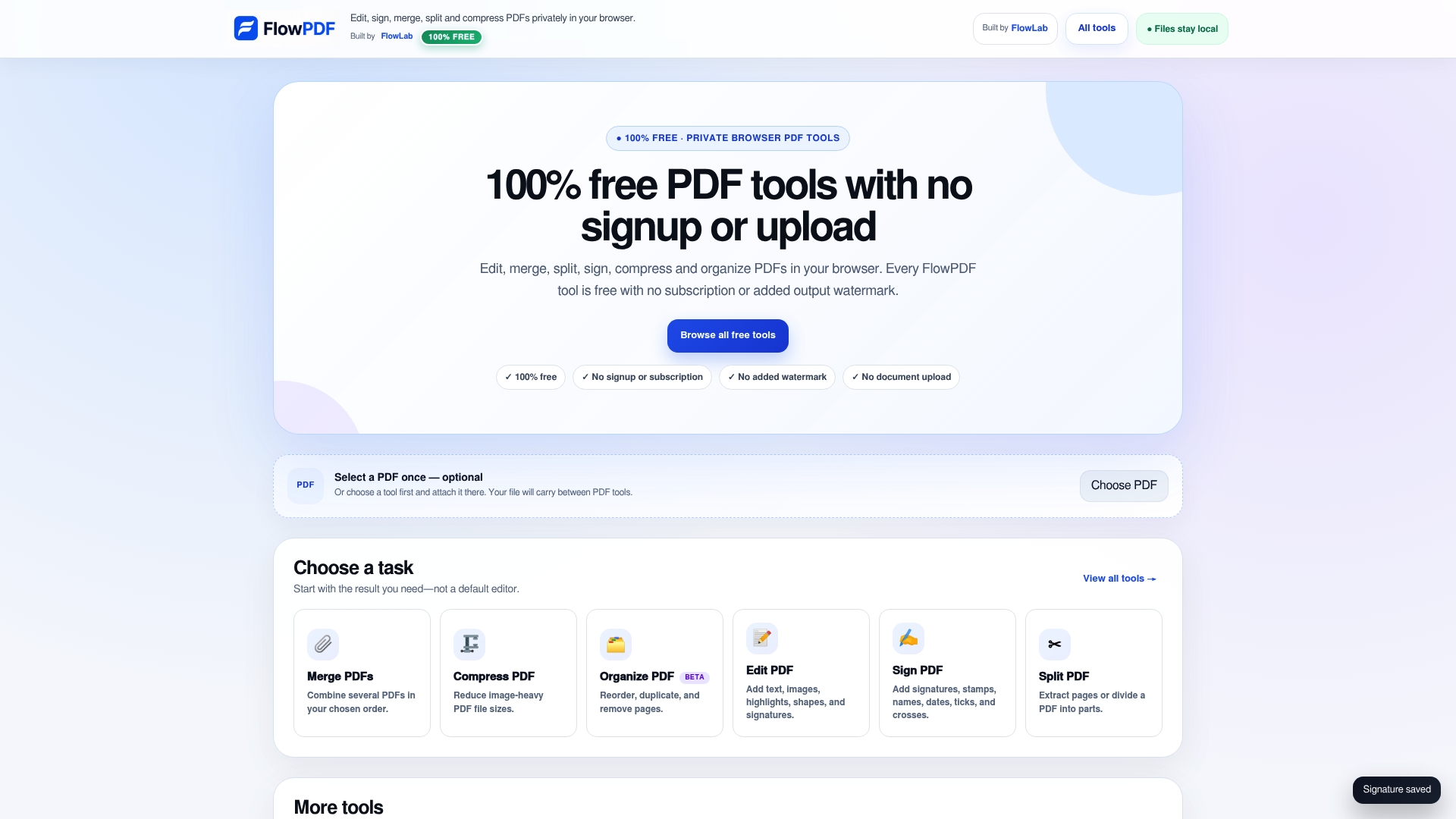
Beyond editing, the same local-processing approach covers merging, splitting, compressing, redacting, and signing, all listed on our free PDF tools page. If you're specifically moving away from Foxit for redaction work, our guide on redacting PDFs locally without uploading walks through how to verify the redaction actually removed the underlying text, not just the visible marks.
Start at Flowpdf, pick the tool that matches your first task, and see the result before you decide whether to make it your default.
FAQ
Is Foxit a Chinese-owned company?
Foxit's ownership structure and public listing are relevant procurement considerations, particularly for institutions handling Controlled Unclassified Information or export-controlled files. Casrai's research notes that some institutions prefer US-headquartered vendors like Adobe Acrobat when ownership factors into procurement policy, so it's worth checking your organization's own compliance requirements directly.
How does Bluebeam compare to Foxit for PDF markup?
Bluebeam and Foxit serve overlapping but distinct audiences: Bluebeam is built heavily around construction and architecture markup workflows, while Foxit covers general-purpose PDF editing. Neither is a universal upgrade over the other, the better fit depends on whether your work centers on construction document review or broader PDF tasks.
What is the best completely free PDF editor?
A completely free PDF editor without watermarks or account requirements is one that processes files locally rather than relying on a freemium upload model. FlowPDF fits that description for common tasks like editing, merging, and signing, since every feature stays free with no watermark added to your export.
Is Foxit or Nitro the better choice for most users?
Foxit and Nitro both offer full-featured desktop editing with OCR and form tools, and user-review comparisons on G2 show overlapping satisfaction across similar feature sets. The better pick depends on your platform, budget, and whether you need Nitro's specific collaboration or e-signature integrations for your team.