
A privacy-conscious way to edit PDFs is to process them locally, in your browser or offline, so the file does not need to reach a server. You can do this with FlowPDF, which we built to edit without uploads. A good tool also strips metadata and lets you verify redaction, in line with NIST SP 800-88 and the PDPA's security expectations.
TL;DR:
- Browser editors can process files locally, but test a dummy PDF with the Network tab open; any large outgoing request signals an upload.
- Redaction must remove underlying text: try selecting and copying the covered area, then search the file for the supposedly deleted words.
- Clear document properties, XMP data, and revision records, then reopen the sanitized copy and confirm its author and software fields are empty or generic.
- Offline desktop apps offer the strongest assurance, while browser tools are quicker; regulated organizations should document tools, assess privacy impacts, and check retention rules.
Table of Contents
- Which privacy-first approaches can you use to edit a PDF?
- What should you check before trusting an editor with sensitive files?
- How do you sanitize metadata and verify redaction?
- Why can WebAssembly and workers keep your files local?
- How do you edit a PDF privately with FlowPDF?
- When is a privacy-first editor the right choice?
- FAQ
- Sources
Which privacy-first approaches can you use to edit a PDF?
You have three realistic routes. Each trades convenience against how much you have to trust.
- Browser built-in editors: Firefox, for example, offers built-in PDF editing that keeps the file in the browser instead of uploading it by default. It suits quick edits like filling a field or adding a signature, but the toolset is thin.
- Offline desktop apps: These give the strongest offline assurance, because the file stays on your disk and the app can run with the network switched off. The trade-offs include installation, updates, and managing local copies yourself.
- Local-processing web apps: Tools built on WebAssembly and web workers combine the convenience of a browser tab with in-memory processing. When they are built properly, the PDF bytes never leave your device. We explain our own approach in our guide to lightweight, no-install editors.
Whatever you pick, watch for the quiet leaks:
- Implicit uploads triggered by a "preview" or "share" button
- Cloud previews that render your file on someone else's server
- Telemetry that reports file names or page counts
- Browser sync that copies downloads to a cloud account
A tool can say "private" on its homepage and still do any of these, so the next section is about testing the claim.
What should you check before trusting an editor with sensitive files?
Run any candidate through this list before you open a contract, tax form, or medical record in it.
- Test the "no upload" claim. Open your browser's developer tools, switch to the Network tab, load a dummy PDF, and edit it. No large outgoing request should appear.
- Confirm redaction deletes content. A black box drawn over text is not redaction if the text underneath can still be selected or copied.
- Check that metadata can be stripped. Look for a way to clear document properties and XMP data.
- Look for telemetry settings. Prefer tools that either collect nothing or let you turn analytics off.
- Favor transparency. Clear security documentation, HTTPS, and a self-contained worker setup are good signs.
Pro Tip: Use a throwaway PDF with fake names and numbers for your first test. Then you can inspect network activity and metadata without risking a real document.
If a tool fails step 1 or step 2, stop there. Everything after that is cosmetic.
How do you sanitize metadata and verify redaction?
Metadata is the part of a PDF most people forget. A document can look clean on screen while its properties still name the author, the software, and the editing history. The fields worth clearing include:
- Document properties such as title, author, subject, and keywords
- XMP data, the embedded metadata block that can carry tool names and timestamps
- Revision and editing history left behind by earlier saves
NIST's SP 800-88 Rev. 2 frames sanitization as making access to the target information infeasible, and it says metadata such as document properties, XMP, and editing history has to be part of that effort. Applied to a PDF, that means removing the data, not just hiding it.
Here is a short routine you can repeat for any document:
- Create a test copy and add the content you plan to redact.
- Apply redaction, then try to select and copy the redacted area. Nothing should come out.
- Clear the metadata and XMP, then reopen the file and inspect its properties.
- Confirm the author, software, and history fields are empty or generic.
- Share only the sanitized copy and keep the original stored securely.
Our walkthrough on removing PDF metadata locally covers the verification step in detail. For regulated workflows, check your organization's data-protection process first. IMDA's Data Protection Starter Kit checklist points to a DPMP, data inventories, and DPIAs, and NIST also advises consulting privacy officers before sanitizing records that may be subject to retention rules.
Why can WebAssembly and workers keep your files local?

Modern browsers give developers real isolation tools, and they matter for you because they explain why a web page can handle a PDF without sending it anywhere. WebAssembly's security documentation describes modules running in a sandbox with memory isolation. When a PDF engine runs entirely inside WebAssembly and a web worker, the file's bytes stay in browser memory and are not exposed to the network by default.
That is a property of how the tool is built, not a promise you have to take on faith. Look for these signs:
- The site loads over HTTPS
- Scripts are self-hosted or protected with subresource integrity
- No external fetch features are used during processing
You can also verify it yourself. Load the page, switch your device offline, and try the edit. If it still works, the processing is local. Then open the Network tab and confirm nothing leaves while you work. Our page on how FlowPDF processes PDFs locally shows how we apply this design.
How do you edit a PDF privately with FlowPDF?
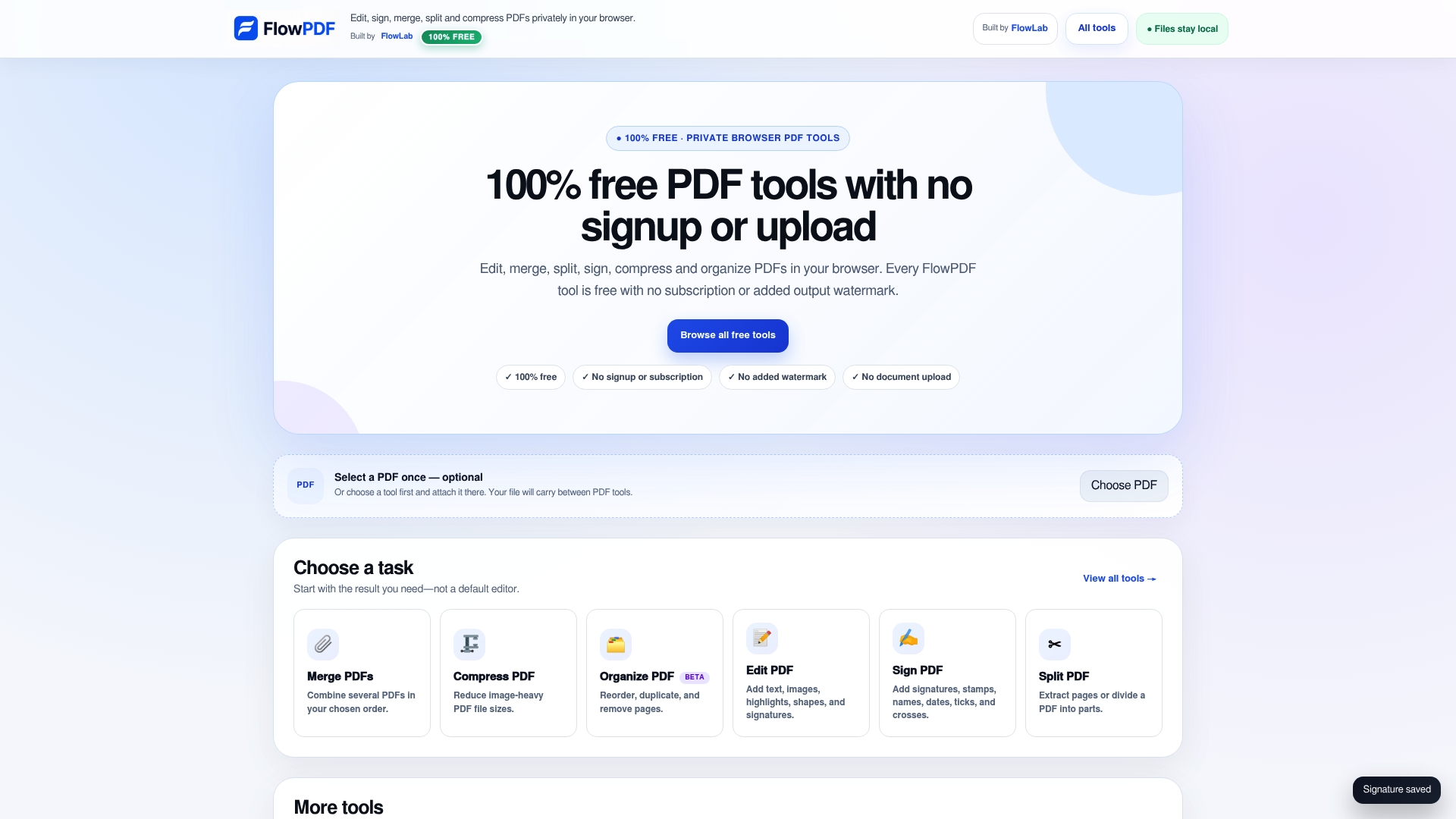
We built FlowPDF around the checklist above. Test whether your files stay in your browser during processing. You can see the available tools on our PDF tools page.
A private edit takes a few steps:
- Open the Edit PDF tool and choose your file.
- Make your changes, or use Redact PDF to redact sensitive text. Verify that the underlying content has been removed.
- Review the document's metadata separately.
- Save the result straight to your device.
Because processing stays local, you can run the same test we recommend above: watch the Network tab while you work. Our post on editing without a watermark explains the details. Open FlowPDF and try it on a sample file today.
When is a privacy-first editor the right choice?
For one-off edits and small teams that handle sensitive files, local processing can be a sensible choice. The risk you remove, a copy of your document sitting on a third-party server, is the one you cannot take back. Larger organizations should consider documenting tools in their data inventories, conducting DPIAs, and adopting Data Protection-by-Design principles, as recommended in IMDA's Data Protection Starter Kit checklist. They can also use the PDPC's resources to formalize their data-protection program. Good documentation habits help too, as this guide to digital documentation shows.
— Ronald Ang
FAQ
What makes a PDF editor privacy friendly?
A privacy-friendly editor processes your file locally and avoids uploading it to a server. Check the tool's behavior to confirm. It also lets you remove metadata and confirm that redaction deletes the underlying content. Telemetry controls and clear security documentation add further trust.
Is a browser-based PDF editor safe for confidential documents?
It can be, when the tool processes files in browser memory and does not send your data in network requests. Check the tool's behavior before using it for confidential documents. You can check this by editing a dummy file with the Network tab open, or by running the tool offline. If anything uploads, do not use the editor for confidential documents until you understand what is being sent and why.
How do I remove metadata from a PDF?
Use an editor that can clear document properties and XMP data, then reopen the file and inspect its properties to confirm the fields are empty. Our metadata removal guide walks through this check.
Does redaction really delete the text underneath?
Only if the tool removes the content instead of covering it. After redacting, try selecting and copying the area, and search the file for the redacted words. If the text appears, the redaction failed.
Sources
- SP 800-88 Rev. 2, Guidelines for Media Sanitization | CSRC
- ADVISORY GUIDELINES ON KEY CONCEPTS IN THE PERSONAL DATA PROTECTION ACT
- Webassembly
- Data Protection Starter Kit Checklist
- Support