
You can remove a PDF password only if you know the correct password, or if the file just has owner restrictions with no open password at all. For many people, a safe and fast fix is a local, in-browser unlocker like FlowPDF, since your file never leaves your device. If you'd rather stay on the desktop, macOS Preview or the command-line tool qpdf handle the job just as well.
TL;DR:
- Removing a PDF password is only possible if you know the open password or if the file only has owner restrictions, with no other encryption.
- Browser-based tools like FlowPDF process files locally, ensuring no data leaves your device, but cannot bypass strong encryption without the password.
- Desktop options such as macOS Preview or Adobe Acrobat require the password and can remove restrictions or encryption directly within the software.
- Command-line tools like qpdf are ideal for automating batch unlocks but require familiarity with scripting, and security depends on cautious password handling.
- Unlocking a PDF without authorization or attempting to bypass strong encryption can have legal implications, and removing digital signatures will invalidate the signed document.
Table of Contents
- How to remove a PDF password: quick methods at a glance
- Steps to remove a PDF password locally in your browser
- Removing a PDF password with macOS Preview or Adobe Acrobat
- Command-line and code options for unlocking PDFs
- Is it safe (and legal) to remove a PDF password?
- Fixing common PDF password errors
- Why local-first unlocking matters more than people realize
- Try FlowPDF's Local PDF Unlocker Instead of Uploading Your File
- Sources
How to remove a PDF password: quick methods at a glance
Not every locked PDF needs the same fix. Your best method depends on what kind of password you're dealing with, how comfortable you are with tech, and how sensitive the document is.
There are two very different problems hiding under "PDF password." A user password (also called an open password) blocks the file from opening at all. An owner password lets the file open freely but restricts printing, copying, or editing. Tools that check for both handle a locked PDF differently depending on which one it finds.
Here's how to choose:
- Local browser tool (like FlowPDF): Best default choice for most people. Works for both open passwords and owner restrictions, and the file stays on your device.
- macOS Preview: Solid if you're on a Mac and already know the open password.
- Adobe Acrobat: Useful if you already pay for it and want a familiar interface.
- qpdf, pypdf, or pdf-lib: Best for developers or anyone unlocking dozens of files at once.
One more thing worth knowing upfront: password recovery is only realistic against older, weaker encryption (40-bit RC4, for example). Modern PDFs typically use 128-bit or 256-bit AES encryption, and there's no practical way to guess or brute-force your way through that if you've genuinely lost the password.
Steps to remove a PDF password locally in your browser
A local unlocker detects, right in your browser tab, whether a PDF has an open password or just owner-level restrictions. That distinction matters because it changes what the tool asks you for. If a browser-based unlocker can decrypt a file entirely client-side using pdf-lib or similar WebAssembly-based methods, your document and password never touch a server.
Here's the process with FlowPDF's unlock PDF tool:
- Drag and drop your file, or click to choose it. Nothing uploads; processing happens on your machine.
- If the PDF has an open password, you'll be prompted to enter it before FlowPDF can decrypt anything.
- If the file only has owner restrictions and opens without a password, the tool can strip those limits with a single click, since detection happens locally and no password is required to remove permission-only locks.
- Download your unlocked PDF and confirm it opens without a prompt.
The one hard limit is that if you don't know the open password, decryption won't work. No local tool, and no legitimate one, can bypass a real open password on a modern AES-encrypted file.
Pro Tip: Before you try to unlock a shared PDF, check the email or message it came with. Senders often include the password separately, and it's usually shorter and less obvious than you'd expect (a birthday, a project code, a client name).
Removing a PDF password with macOS Preview or Adobe Acrobat
If you're not big on browser tools, your operating system or existing software probably already has what you need.
On a Mac, Preview handles this natively:
- Open the PDF and enter the password when prompted.
- Go to File, then Export as PDF.
- Save the new copy. It opens with no password required.
In Adobe Acrobat:
- Open the file (you'll need the password if one exists).
- Go to Tools, then Protect, then Remove Security.
- Confirm, then save the unprotected file.
Some desktop apps can strip owner-only restrictions without ever asking for a password, since there's nothing to decrypt if the file already opens freely. Just be aware that free versions of many PDF apps limit batch processing to one file at a time. Genuine bulk unlocking, especially in Adobe, is commonly a paid feature.
Command-line and code options for unlocking PDFs
For anyone managing more than a handful of files, scripting beats clicking. qpdf handles every encryption type reliably and is the tool most developers reach for first.
- qpdf: Run
qpdf --decrypt --password=yourpassword input.pdf output.pdf. Loop it over a folder with a basic shell script for batch jobs. - pdf-lib (Node.js): Load the PDF with
PDFDocument.load(bytes, { password }), then save it without encryption options. - pypdf (Python): Use
PdfReader(file, password="yourpassword"), check the decrypt return value, then write out an unencrypted copy.
Avoid storing passwords in your shell history or script logs. If you're automating this at scale, pass credentials through environment variables instead of hardcoding them.
Is it safe (and legal) to remove a PDF password?
Local processing genuinely changes your risk profile. When a tool decrypts entirely inside your browser, your file and password never cross the internet, which sidesteps the exposure that comes with uploading sensitive documents to a third-party server.
That said, safety and legality both come with real limits:
- You need authorization to unlock a file. Removing password protection from a document you don't own or don't have permission to access can carry legal consequences, even if the technical steps are trivial.
- Unlocking a signed PDF invalidates its digital signature by design. If the signature matters (contracts, notarized documents), work on a copy and keep the signed original untouched.
- To verify a tool's privacy claims, check its documentation, open your browser's network tab during the process, and skim its privacy policy. FlowPDF documents exactly how its local processing works for readers who want the technical detail.
Plenty of online unlockers advertise fast turnaround but still require an upload, leaning on TLS encryption and short retention windows to reassure users. That's a reasonable middle ground for low-stakes files, but it's not the same guarantee as processing that never leaves your device.
Fixing common PDF password errors
Most failed unlock attempts come down to a handful of predictable problems.
- Wrong password: Check for Caps Lock, extra spaces, or a similar-looking password used on a different file.
- Corrupted file: Try opening it in a different viewer before assuming the password is the issue.
- Genuinely forgotten password: If the file uses modern AES encryption, recovery is unlikely without the actual credential. Be skeptical of any service promising to "crack" a strong password. Most only succeed against weak, outdated encryption.
- You have rights but no password: Go back to whoever sent the file and request an unlocked copy directly.
Why local-first unlocking matters more than people realize
Most guides treat PDF password removal as a purely mechanical problem: find a tool, click unlock, move on. What gets underplayed is how much your choice of tool determines what happens to your data in the process, especially for tax documents, signed contracts, or anything with a client's name on it.

I've watched the online tool market fill up with server-side unlockers that market themselves on speed and convenience while quietly routing your file through a remote server first. That's not necessarily reckless, but it's an unnecessary risk for a task that a browser can now handle entirely on its own. Client-side decryption using pdf-lib or WebAssembly isn't a niche feature anymore; it's a mature, dependable approach that removes the upload step from the equation entirely.
FlowPDF builds on that same approach across its unlock and protect tools, and it does so without gating any feature behind a paywall or slapping a watermark on your redacted documents. That combination, full functionality, zero cost, nothing leaving your browser, is rarer than it should be in this category.
— Ronald Ang
Try FlowPDF's Local PDF Unlocker Instead of Uploading Your File
FlowPDF handles the exact problem this article just walked through: unlocking a PDF when you know the password, or stripping owner restrictions when you don't need one at all, without ever sending your document to a server. That's the real difference between FlowPDF and typical online unlockers. Your file stays on your machine from start to finish.
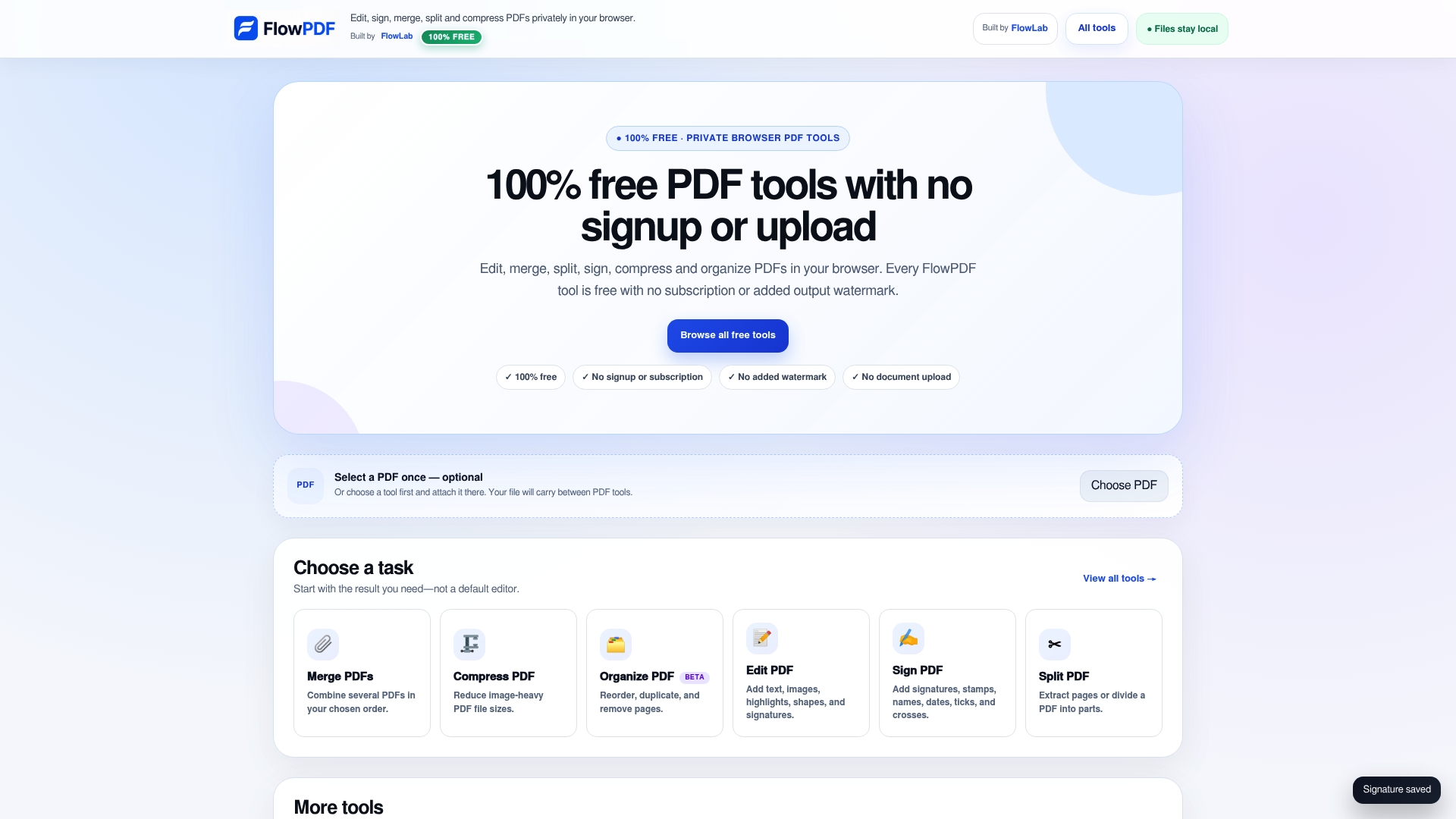
Getting started takes under a minute. Head to FlowPDF's unlock PDF page, drop in your file, enter the password if the tool asks for one, and download your unlocked copy. There's no signup, no watermark, and no hidden tier for "advanced" features. Once your PDF is unlocked, you can jump straight into editing it privately using the same no-upload approach. If you ever need to lock a document back down before sharing it again, the protect PDF tool works the same way, entirely in your browser.
Sources
- Unlock PDF: Remove a Known Password, No Upload | Gizmoop
- How to remove a password from a PDF (free, no Adobe needed)
- Free PDF Unlock — Remove PDF Password & Restrictions, No Upload | FWD Tools
- how to remove pdf file password on Mac?