
The fastest, safest way to remove PDF metadata is a local in-browser tool that strips the Info dictionary and XMP packet without ever uploading your file. This clears hidden details like author name, software version, and edit history, but it leaves your visible text, images, and layout exactly as they were. For most people, that's the whole job: open the file, strip the metadata, download it clean.
TL;DR:
- Using a local in-browser tool is the safest and fastest method for one-time PDF metadata removal, as it never uploads your file to a server.
- To fully erase metadata, you must clear both the Info dictionary and XMP packet, since tools that only remove one leave recoverable fields behind.
- Desktop editors require manual deletion of metadata fields through properties or inspector panels, best done before exporting the clean PDF.
- Command-line techniques like
qpdf,pdftk, andexiftooloffer deep cleaning by rewriting files and removing embedded metadata streams, but may require verification.- Always verify metadata removal by checking document properties, running inspection tools, and searching raw file content to confirm all hidden data is gone.
Table of Contents
- Which Method Should You Use to Remove PDF Metadata?
- How Do You Remove PDF Metadata in a Browser?
- How Do You Remove Metadata in Desktop PDF Editors?
- Command-Line and Byte-Level Techniques for Deep Cleaning
- How Do You Confirm the Metadata Is Actually Gone?
- When Metadata Cleaning Isn't Enough
- Pre-Share Checklist for Cleaned PDFs
- Author Perspective: A Privacy-First Approach to Metadata Cleaning
- Clean Your PDFs Privately With FlowPDF
- Sources
Which Method Should You Use to Remove PDF Metadata?
Your choice depends on how many files you have and how deep you need to go. A one-off contract or resume calls for a browser tool. A batch of client files calls for a desktop editor. A stubborn PDF that keeps leaking metadata calls for the command line.
- In-browser tool: upload nothing, open the file locally, select a "remove metadata" preset, download the cleaned version. Best for single files and non-technical users.
- Desktop editor: open Document Properties or the Document Inspector, delete each field manually, then export or save a new copy. Best for people already working in a full editor.
- Command line: run a rewrite tool like
qpdforpdftkalongsideexiftool, then verify with a metadata dump. Best for developers or anyone processing dozens of files at once.
Uploading a file to a cloud service means it briefly sits on someone else's server, even if deleted afterward. A tool that runs entirely in your browser never sends the document anywhere, which is why privacy-conscious users lean toward local processing.
How Do You Remove PDF Metadata in a Browser?
A PDF actually stores metadata in two separate places: the older Info dictionary and the newer XMP packet. A tool that only clears one of these can leave the other fully intact, so the fields you thought were gone are still sitting in the file, recoverable with the right inspector. This is the single biggest reason people think they've cleaned a file when they haven't.
Because browser-based tools keep the document on your device the whole time, there's no upload step to worry about and no server copy to track down later.
The workflow itself is simple:
- Open the PDF in the tool and let it scan the file for existing metadata fields.
- Review what's listed: author, title, creation date, software, and sometimes GPS or company fields.
- Choose a preset, either a light clean (title and author only) or a full strip (every field, both stores).
- Download the cleaned file and keep the original separately.
Pro Tip: If your PDF contains scanned photos or screenshots, use the maximum-privacy preset. Standard metadata presets often skip the EXIF data buried inside embedded images, which can still carry a GPS location or camera model.
How Do You Remove Metadata in Desktop PDF Editors?
Metadata in a desktop-created PDF usually comes from two sources: the properties you set inside the editor and the properties inherited from the original document (a Word file, a spreadsheet, a scanned image). Most desktop applications expose these through a Document Properties panel or a dedicated Document Inspector, which lets you view and delete fields before exporting.
The steps are consistent across most editors:
- Open File > Properties (or Document Properties) and locate the Author, Title, and Company fields.
- Clear each field manually, or use a built-in "Remove Personal Information" option if one exists.
- Save a new copy rather than overwriting, so you keep a clean audit trail.
- Re-export to PDF if the source file itself still holds tracked changes or comments.
The smarter order of operations is to clean the source document first, removing tracked changes and personal details, and only then export to PDF and run a dedicated metadata stripper on the result. Export tools frequently reinsert metadata (software name, timestamp) during the conversion step, which a source-only cleanup misses.
Command-Line and Byte-Level Techniques for Deep Cleaning
Simple property editors work on the surface layer of a PDF, but modern files often compress their internal object streams, which is exactly where extra metadata likes to hide. Advanced cleaners solve this by inflating those compressed streams, blanking the metadata inside them, and re-deflating the file, a byte-level reserialization approach that catches what property panels miss.
Common command-line workflows include:
- Rewriting the file with
qpdforpdftkby copying pages into a fresh document, which drops the old Info dictionary. - Running
exiftool -all=to clear remaining XMP fields and embedded metadata objects. - Linearizing the output to rebuild the file structure instead of patching it in place.
Pro Tip: Don't assume one pass is enough. A widely referenced troubleshooting thread notes that page-copying rewrites can still leave stray metadata objects behind, so pair the rewrite with a fresh scan afterward. Some deletions are reversible in practice too, since old incremental-update fragments can preserve deleted XMP entries unless the file is fully rebuilt rather than edited in place.
How Do You Confirm the Metadata Is Actually Gone?
Never trust a "cleaned" label without checking. A three-step verification catches almost everything a single check would miss.
- Open File → Properties (or Document Properties) in your PDF viewer and confirm the Author, Title, and Subject fields are blank.
- Run the file back through your cleaning tool's own inspector, or a command-line report, to see a full metadata dump rather than a summary view. Verification should stack multiple checks rather than rely on one panel, since the Info dictionary and XMP packet can disagree.
- As a final gut check, open the PDF in a plain text editor or run a quick search for your name, company, or software string across the raw file. If nothing turns up, the file is genuinely clean.
When Metadata Cleaning Isn't Enough
Stripping metadata only touches the file's hidden properties. It does nothing to the visible page content, and it's easy to confuse the two.
- Metadata removal does not delete visible text, images, form field values, or comments on the page.
- It does not remove attachments, embedded files, or annotations layered on top of the document.
- Signed and encrypted PDFs are a special case: rewriting them can invalidate the signature or break the encryption, so a good cleaner should either preserve or reject those files rather than silently rewrite them.
- Metadata cleaning is not redaction; if sensitive text is visible on the page, you need a dedicated redaction tool, not a metadata stripper.
If a document contains sensitive content in the body itself, your next move is redaction or recreating the file from a cleaner source, not a second metadata pass.
Pre-Share Checklist for Cleaned PDFs
Run through this before you hit send:
- Confirm the metadata fields are actually blank using a viewer check, not just a "success" message.
- Scan the visible pages for names, addresses, or account numbers the metadata pass wouldn't have touched.
- Decide upfront whether the file needs to stay signed or encrypted, since cleaning tools should never silently alter either.
- Keep the original file untouched and store the cleaned version separately so you can prove what changed.
Author Perspective: A Privacy-First Approach to Metadata Cleaning
. What I keep coming back to is this: the tool matters less than the habit of checking. People assume metadata removal is a one-click guarantee, but the Info dictionary and XMP packet don't always clear together, so skipping verification is where most "clean" files actually fail. Run the check every time, not just when a file feels sensitive.
— Ronald Ang
Clean Your PDFs Privately With FlowPDF
There are browser-based metadata tools for anyone who'd rather not send a resume, contract, or scanned ID to a stranger's server. Every step, from inspecting existing fields to stripping the Info dictionary and XMP packet, runs locally in your browser, so the file never leaves your device.
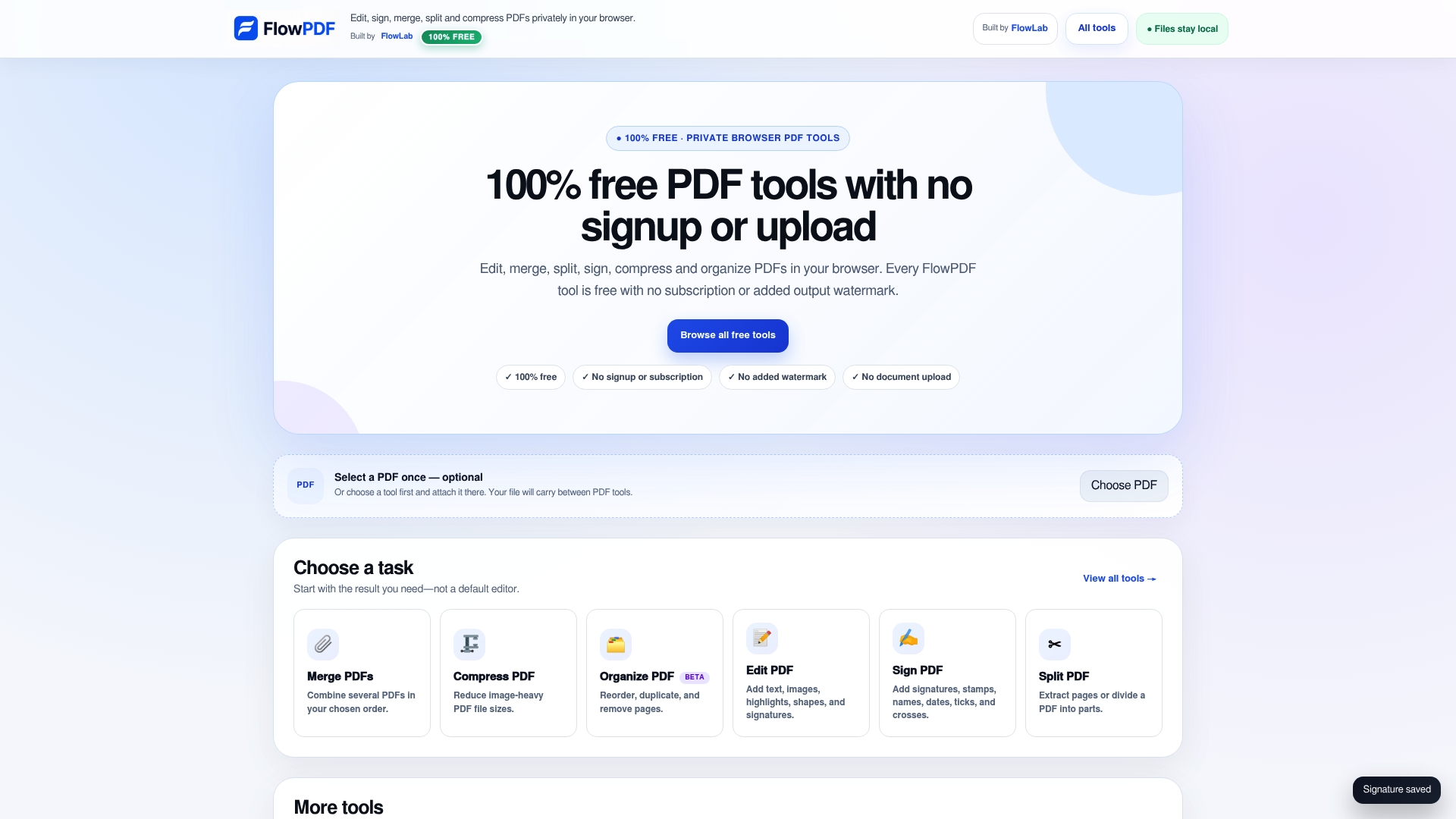
Beyond metadata removal, some online toolkits cover the follow-up work this guide walks through: redact visible sensitive content that metadata cleaning can't touch, or remove specific pages before sharing a longer document. Often, no watermark is added, no subscription is required, and no account needs to be created. Open the edit PDF tool now, drop in your file, and run the inspect-and-strip workflow before your next document goes out the door.
Sources
For deeper technical detail: metadata field reference and dual-store explanation, byte-level reserialization approach, Microsoft's Document Inspector guidance, and quick file-safety checks before sharing.
- MetaScrub — in-browser metadata cleaning
- Remove PDF metadata — remove-metadata.tools
- Strip PDF Metadata — Ghoststrip
- Remove hidden data and personal information by inspecting documents - Microsoft Support