
For most everyday PDF work, including editing, filling forms, and light signing, FlowPDF is the strongest pdfFiller alternative because it runs entirely in your browser, keeps files off any server, and costs nothing. If you need heavy document editing across a large team, Adobe Acrobat Pro or Foxit PDF Editor fit better. If a signature must carry legal weight in Singapore, you need a Secure Electronic Signature (SES) provider like Sign with Singpass or Netrust, not a basic drawn signature. Automating high-volume document processing points you toward PDF.co.
TL;DR:
- FlowPDF processes all PDF edits locally in your browser, keeping files off servers and offering free tools without watermarks, ideal for sensitive documents.
- For legally recognized signatures in Singapore, users must choose a certificate-backed SES provider like Sign with Singpass or Netrust, not basic signature overlays.
- Heavy document editing at scale requires enterprise solutions like Adobe Acrobat Pro or Foxit PDF Editor, which support detailed controls and collaboration features.
- High-volume automation tasks are best handled by PDF.co's API platform, which offers OCR, webhooks, and developer integrations, not manual editing.
- For quick, one-off tasks such as filling forms or merging files, simple browser tools like Smallpdf and Sejda are convenient, but files must be uploaded to their servers.
Table of Contents
- Which PDF Filler Alternative Fits Your Job?
- How We Evaluated These Alternatives
- Per-Product Mini-Reviews: FlowPDF and 19 Other Alternatives
- Why FlowPDF Stands Out as a Privacy-First Free Alternative
- Customer Support and Service Options
- User Interface and Ease of Use Compared
- Choosing Between Lightweight Tools and Enterprise Editors
- FlowPDF: The Direct Pick for Free, Private PDF Editing
- Primary Sources and Further Reading
- Sources
- FAQ
Which PDF Filler Alternative Fits Your Job?
The right pick depends on what you're actually doing with the file, not which tool has the longest feature list. A one-off rental agreement needs different tools than a stack of 500 invoices or a contract that has to hold up in a Singapore court.
Here's how the main jobs map to the strongest options:
| Job | Recommended option | Pricing cue | Processing model | Standout feature |
|---|---|---|---|---|
| Everyday edit, fill, and basic sign | FlowPDF | Free, no watermark | Local (browser) | No uploads, full toolset at no cost |
| Legally presumptive signing (SES) | Netrust nSignHub or Sign with Singpass | Paid certificates / integration | Cloud, PKI-based | Certificate-backed signatures courts recognize |
| Heavy document editing at scale | Adobe Acrobat Pro or Foxit PDF Editor | Paid subscription | Cloud + desktop | Object-level editing, redaction, enterprise controls |
| Quick one-off browser tasks | Smallpdf, Sejda PDF Editor, or iLovePDF | Free tier, paid limits | Cloud upload | Fast, simple utilities |
| High-volume automation | PDF.co | Paid, usage-based | Cloud API | OCR, webhooks, developer connectors |
A few things explain why these picks land where they do:
- FlowPDF wins the everyday category because it never sends your document anywhere. That matters for tax forms, medical records, or contracts you'd rather not park on a third-party server.
- SES-capable tools matter specifically in Singapore. Under the Electronic Transactions Act, a Secure Electronic Signature like Sign with Singpass carries a legal presumption of validity that an ordinary drawn signature does not.
- Enterprise editors earn their subscription cost when multiple reviewers need audit trails, redaction, and object-level control across large document sets, something a lightweight browser tool isn't built for.
- Automation platforms like PDF.co are the right call only when you're processing documents programmatically, not editing them by hand one at a time.
If your task is filling out a form today, the fastest route is FlowPDF's free PDF tools. If your task requires a signature that stands up legally, skip straight to the SES section below.
How We Evaluated These Alternatives
Ranking PDF tools by star rating alone tells you almost nothing about whether a tool fits your job. We evaluated each alternative against seven practical axes:
- Editing depth (text, images, object-level changes)
- Form-filling and form-creation tools
- Signature type: OES (basic, drawn or typed) versus SES (certificate-backed, legally presumptive)
- File-handling policy: does the file get uploaded to a server, or processed locally
- Collaboration and audit-log features
- API and automation availability
- Pricing structure and whether a genuine free tier exists
We drew on vendor documentation, Singapore government e-signature guidance from the Singapore Government Developer Portal, and independent product reviews including G2's PDF editor testing roundup.
One distinction shaped the whole comparison: a drawn or typed signature overlay is not the same thing as a cryptographically verifiable digital signature. That difference decides whether a document is defensible if a signature is ever disputed. Product features also change often, so treat this as a snapshot and check current plan pages before committing to a paid tier.
Per-Product Mini-Reviews: FlowPDF and 19 Other Alternatives
Each profile below covers what the tool actually is, why it's worth considering, where it falls short, what it costs, and who it fits best.
FlowPDF
Some browser-based PDF toolkits cover editing, merging, splitting, compressing, signing, redacting, form-filling, and more, all processed locally with no file upload, with free features and no output watermark, which is unusual in a market where most competitors gate advanced tools behind a subscription.
Why consider it: your document never leaves your device, which removes an entire category of risk for tax forms, medical paperwork, or client contracts. Potential limitation: it handles OES-style signatures (drawn, typed, or uploaded image), not certificate-backed SES, so it isn't the tool for a transaction that legally requires a Singapore-recognized digital signature. Pricing: free, with no account required. Best for: freelancers, students, and privacy-conscious individuals or small businesses doing routine PDF work.

PDF.co
PDF.co is an API-first platform built for developers who need to process PDFs programmatically rather than by hand. It offers OCR, webhooks, and pre-built connectors for automation pipelines.
Why consider it: if your business generates hundreds of invoices or forms a week, an API beats manual editing every time, a point PDF.co's own comparison of pdfFiller alternatives makes clearly. Potential limitation: it isn't designed for a person who just needs to fill out one form today, since it assumes a developer is wiring it into a workflow. Pricing: usage-based paid plans. Best for: engineering and operations teams automating document-heavy processes.
Adobe Acrobat Pro
Adobe Acrobat Pro remains the industry benchmark for object-level PDF editing, spanning desktop, web, and mobile with enterprise-grade signing integrations. It supports deep redaction, OCR, and form design that goes beyond what browser tools attempt.
Why consider it: when a legal or compliance team needs granular control over every element on a page, Acrobat Pro's editing depth is hard to match. Potential limitation: the subscription cost adds up fast for individuals or small teams with occasional needs. Pricing: paid subscription tiers. Best for: organizations that edit complex PDFs daily and need enterprise signing workflows.
Foxit PDF Editor
Foxit PDF Editor targets business users who want advanced editing without Adobe's full price tag, paired with strong security controls for regulated industries. It supports enterprise deployment across an organization's device fleet.
Why consider it: security-conscious IT teams often prefer Foxit's granular permission controls when rolling out PDF tools company-wide. Potential limitation: casual users will find more features than they need, which adds a learning curve for simple tasks. Pricing: paid, with tiered business licensing. Best for: mid-size to large organizations needing centralized deployment and editing controls.
Nitro PDF Pro
Nitro PDF Pro leans into a desktop-first experience styled after Microsoft Office, which shortens the learning curve for teams already comfortable in that ecosystem. Its editing and document-productivity tools are built for repeat daily use.
Why consider it: if your staff already lives in Word and Excel, Nitro's interface feels immediately familiar. Potential limitation: it's less suited to teams that need a fully browser-based, install-free workflow. Pricing: paid desktop licensing. Best for: teams standardized on a Windows desktop environment.
PDFelement
PDFelement offers a broad editing feature set, including AI-assisted tools for summarizing and organizing documents, at a price point well below Adobe's. It covers most of what a power user needs without the enterprise price tag.
Why consider it: you get the bulk of a premium editor's functionality without a premium editor's cost. Potential limitation: some advanced enterprise features (deep audit logs, granular admin controls) aren't as developed as in Acrobat or Foxit. Pricing: one-time purchase and subscription options available. Best for: individuals and small businesses wanting full editing power on a budget.
Smallpdf
Smallpdf is a browser-first collection of PDF utilities, compression, conversion, and quick edits, built for people who need a task done in under a minute. Its interface is about as simple as PDF tools get.
Why consider it: for a one-off compress-and-send task, Smallpdf's simplicity beats installing anything. Potential limitation: files are uploaded to Smallpdf's servers for processing, which matters if the document is sensitive. Pricing: free tier with daily limits, paid plans for unlimited use. Best for: casual users handling occasional conversion or compression tasks.
Sejda PDF Editor
Sejda PDF Editor serves the same casual-edit niche as Smallpdf but adds a desktop app option for users who want offline access. It handles annotations, basic edits, and form-filling reasonably well.
Why consider it: the desktop-web parity gives you flexibility that pure browser tools don't. Potential limitation: like most browser tools, the online version requires uploading your file. Pricing: free with usage caps, paid for higher volume. Best for: people who occasionally need both online and offline editing.
Soda PDF
Soda PDF blends a web app with a desktop client, aiming at users who want to switch between the two depending on context. Its feature set covers basic to intermediate editing needs.
Why consider it: the hybrid model suits someone who edits on a work laptop sometimes and a personal browser other times. Potential limitation: neither the web nor desktop experience matches the editing depth of Acrobat or Foxit. Pricing: paid subscription with a limited free trial. Best for: users who want flexibility between web and desktop without committing to one interface.
PDFescape
PDFescape is a lightweight, free browser editor built for basic annotation and form-filling rather than heavy editing. It strips out complexity in favor of speed.
Why consider it: if all you need is to fill a form and add a signature, PDFescape does that without asking you to learn a new interface. Potential limitation: it isn't built for detailed layout editing or large documents. Pricing: free with a paid tier for larger files. Best for: people needing quick, basic form-filling in a browser.
Able2Extract Professional
Able2Extract Professional specializes in converting PDFs into editable formats and extracting structured data, particularly tables, out of static documents. That's a narrower job than general editing, but it does it well.
Why consider it: if your real pain point is pulling a table out of a PDF into Excel without manually retyping it, this tool is built for exactly that. Potential limitation: it's not a general-purpose editor or signing tool. Pricing: paid, with tiered licensing. Best for: analysts and accountants who regularly extract data from PDF reports.
DocHub
DocHub is a cloud-based editor built around signing and collaborative document workflows, letting multiple people mark up or sign the same file. It integrates with cloud storage services for easy sharing.
Why consider it: if your workflow involves passing a document among several reviewers before final signature, DocHub's collaboration tools streamline that back-and-forth. Potential limitation: files are stored and processed in the cloud, so it's not the choice for maximum privacy. Pricing: free tier available, paid for advanced features. Best for: small teams collaborating on document review and signing.
Jotform
Jotform's core product is a form builder, but it extends into generating PDF outputs from submitted forms and collecting e-signatures. It's a fundamentally different tool than a PDF editor.
Why consider it: if your actual need is collecting responses from many people and turning them into PDFs, Jotform's form-first approach beats editing PDFs one at a time. Potential limitation: it's not designed for editing an existing PDF someone hands you. Pricing: free tier with limits, paid plans for volume. Best for: businesses collecting structured data through online forms.
Adobe Acrobat Reader
Adobe Acrobat Reader is the free viewing app most people already have installed, with some light annotation tools and an upgrade path into full Acrobat Pro. It's the default for opening PDFs, not editing them.
Why consider it: universal compatibility means anyone you send a file to can open it without installing anything new. Potential limitation: real editing requires the paid Acrobat Pro upgrade. Pricing: free to view, paid to unlock editing. Best for: anyone who primarily needs to view and lightly annotate PDFs.
iLovePDF
iLovePDF offers simple browser utilities for converting, merging, and lightly editing PDFs, similar in spirit to Smallpdf. Its interface favors speed over depth.
Why consider it: for a quick merge-and-send job, iLovePDF gets it done in a couple of clicks. Potential limitation: files are uploaded for processing, and deeper editing isn't the focus. Pricing: free tier with limits, paid for unlimited use. Best for: users needing fast, basic conversion and merging.
Zoho Forms
Zoho Forms fits businesses already using Zoho's suite, generating PDF outputs and collecting signatures as part of a broader form-to-document workflow. Its strength is integration, not standalone PDF editing.
Why consider it: if your operations already run through Zoho CRM or Zoho Books, this keeps everything in one ecosystem. Potential limitation: it's not useful if you're not already invested in Zoho's platform. Pricing: paid tiers tied to Zoho subscriptions. Best for: businesses standardized on the Zoho ecosystem.
Form Organizer
Form Organizer is aimed at organizations managing large volumes of forms and structured data extracted from PDFs, rather than one-off editing. It's a document-management play more than an editor.
Why consider it: for teams drowning in paper-to-digital form conversion, a dedicated form-management tool beats manual PDF editing. Potential limitation: it's a narrower tool than a full PDF suite, so pair it with an editor for other tasks. Best for: organizations managing high volumes of structured forms.
Form+
Form+ focuses on form building and generating PDFs from those forms, serving teams whose core workflow is form-driven rather than document-driven. Its automation centers on turning form submissions into finished PDFs.
Why consider it: if your team builds recurring intake forms, Form+ automates the PDF generation step. Potential limitation: it doesn't replace a general PDF editor for existing documents. Best for: teams building repeatable, form-centric document processes.
GlobalForms
GlobalForms targets enterprises that need structured form workflows with broader system integrations, more of a platform than a single tool. It's built for scale rather than individual use.
Why consider it: large organizations with complex form-approval chains benefit from its integration options. Potential limitation: it's overbuilt for anyone who just needs to edit or sign a PDF occasionally. Best for: enterprises with structured, multi-step form workflows.
GoFormz
GoFormz is built for field teams capturing data on mobile devices and converting that data into finished PDF reports. Its mobile-first design sets it apart from browser or desktop editors.
Why consider it: inspection reports, delivery confirmations, and field audits benefit from mobile capture that becomes a formatted PDF automatically. Potential limitation: it's not built for general desktop PDF editing. Best for: field service and inspection teams needing mobile data capture.
Why FlowPDF Stands Out as a Privacy-First Free Alternative
Most PDF tools ask you to trade something, a subscription fee, a watermark, or your file sitting on someone else's server, for convenience. FlowPDF's product pages describe a different model: every core PDF operation runs locally in your browser, and the file never gets uploaded anywhere.
FlowPDF processes documents entirely on your device, with no file uploads, no signup requirement, and no watermark added to the finished PDF, according to the publisher's own product documentation.
That claim matters most for anyone handling sensitive material: signed contracts, medical intake forms, or financial statements you'd rather not park on a third-party server even temporarily.
Where to verify the claims yourself:
- How FlowPDF processes PDFs locally, the technical explanation of the no-upload model
- FlowPDF's fill-PDF-forms feature, for readers comparing form-filling specifically
- FlowPDF's editing feature page, for a closer look at what "edit" actually covers
Customer Support and Service Options
Support quality varies more across this category than most buyers expect, and it correlates closely with price. Enterprise tools like Adobe Acrobat Pro and Foxit PDF Editor typically offer phone support, dedicated account managers, and formal service-level agreements for business tiers, the kind of backup a legal or finance department wants when a signing deadline is on the line.
Mid-tier tools like PDFelement, Nitro PDF Pro, and Soda PDF generally offer email support and knowledge-base documentation, with faster response times reserved for paid plans. Free browser tools, including Smallpdf, iLovePDF, PDFescape, and Sejda PDF Editor, mostly rely on self-serve help centers and community forums since there's no subscription revenue to fund a support team.
Some free PDF tools do not have paid support tiers, removing certain friction points such as account or billing issues to escalate. For a routine task like merging two files or filling a form, that simplicity often matters more than having a support ticket queue to fall back on. Automation platforms like PDF.co sit in their own category here, since developer-facing tools tend to offer API documentation and technical support channels rather than consumer-style help desks. If your work depends on guaranteed response times, weigh that requirement into your choice as heavily as any editing feature.

User Interface and Ease of Use Compared
Interface complexity tracks almost perfectly with feature depth in this category, and that trade-off is worth naming plainly. Adobe Acrobat Pro and Foxit PDF Editor pack in enormous capability, but new users often need real onboarding to find redaction tools, form-field settings, or advanced export options buried in nested menus.
Browser-first tools take the opposite approach. FlowPDF, Smallpdf, iLovePDF, and PDFescape strip the interface down to a handful of visible actions, so a first-time visitor can usually complete a task without instructions. Nitro PDF Pro and Soda PDF sit in the middle, offering Office-style ribbons that feel familiar to anyone who's used Microsoft Word but still take longer to master than a single-purpose browser tool.
The clearest way to judge fit is to ask how often you'll use advanced features. If you're merging or signing files a few times a month, a cluttered enterprise interface slows you down more than it helps. If you're doing complex redaction or multi-layer editing daily, that same complexity becomes justified because the tool is built for depth, not speed of first use.
Pro Tip: Before committing to any tool, try the exact task you do most often, whether that's filling one form or merging three files, and time how long it takes from opening the page to finishing. That single test reveals more about fit than any feature comparison chart.
Choosing Between Lightweight Tools and Enterprise Editors
Privacy and audit trails pull in opposite directions: local tools protect your file, while enterprise platforms track every change for compliance. Use an SES-capable provider for anything legally binding in Singapore. For everyday edits and fills, FlowPDF covers the job without cost or upload risk.
— Ronald Ang
FlowPDF: The Direct Pick for Free, Private PDF Editing
FlowPDF is the alternative to upload-and-hope PDF tools for everyday editing and filling: your document stays on your device, every core feature is free, and nothing comes back with a watermark stamped across it. If you've read through the enterprise editors and browser tools above and just need to fill a form, merge a few pages, or sign something low-stakes today, that's exactly the gap FlowPDF fills.
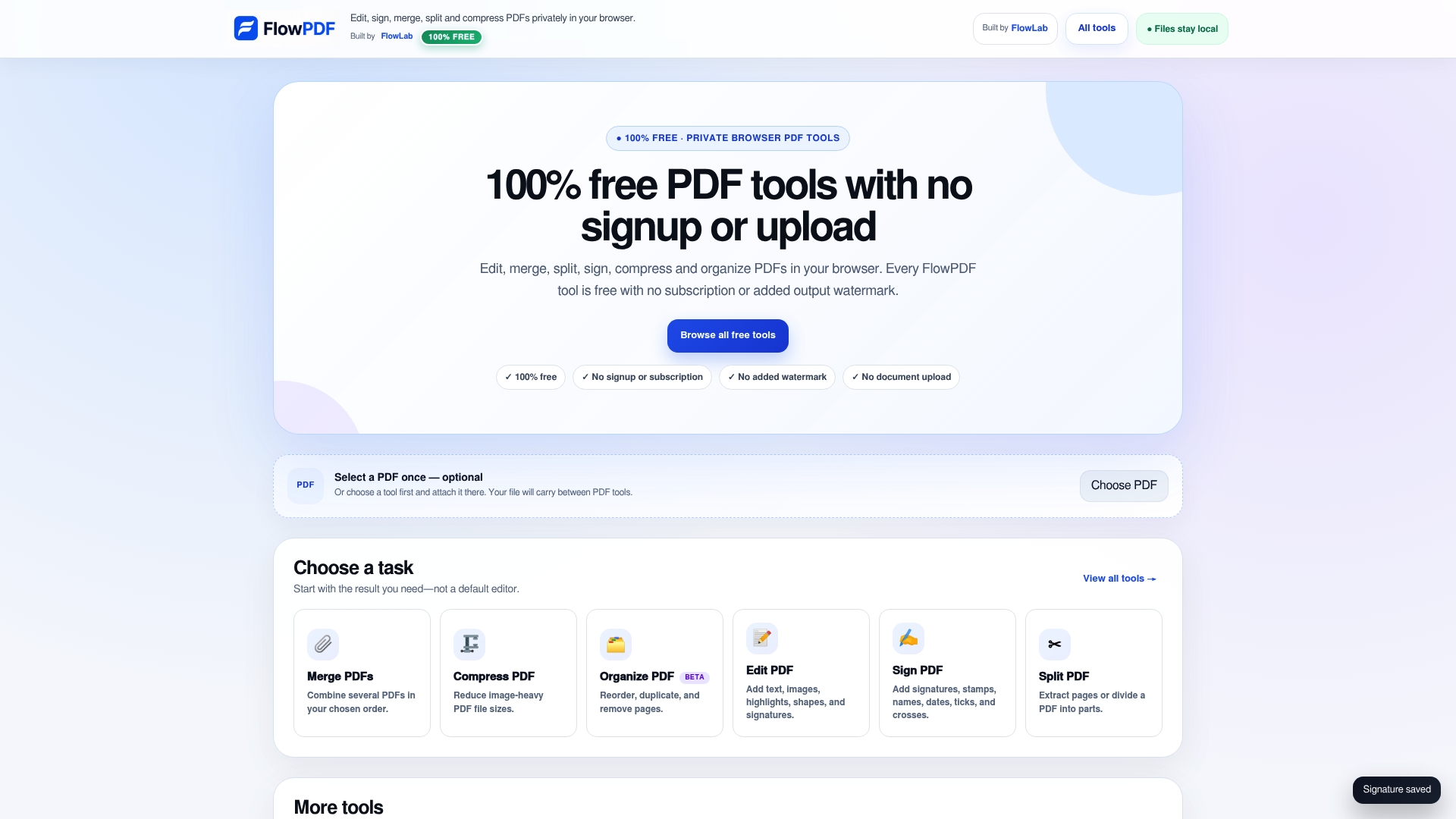
It won't replace a certificate-backed SES provider like Sign with Singpass or Netrust when a document legally requires that level of signature, and it's not built for teams needing shared audit logs across dozens of reviewers. For everything short of that, from editing contracts to redacting sensitive pages to converting an image into a PDF, it does the job without asking for your file, your email, or your card details. Start with the free PDF tools page and try the exact task you came here for.
Primary Sources and Further Reading
- E-Signatures | Singapore Government Developer Portal, the official guidance distinguishing SES from OES under the Electronic Transactions Act
- How do our digital signatures work – Sign with Singpass docs, explaining PKI-based signing and document integrity verification
- nSignBasic – Netrust, certificate-based SES signing trusted by Adobe and Microsoft
- nSignHub – Netrust, SES implementation supporting Sign with Singpass with Singapore-based hosting
- 10 Best pdfFiller Alternatives in 2026 – PDF.co, industry comparison referenced for free-tier and automation claims
Sources
- E-Signatures | Singapore Government Developer Portal
- nSignBasic – Netrust
- How do our digital signatures work – Sign with Singpass docs
FAQ
Is There a Free Version of pdfFiller?
pdfFiller itself offers a limited trial rather than a genuinely free ongoing plan, which is why many people search for pdfFiller alternatives with a real free tier. FlowPDF provides its full toolset, editing, merging, splitting, signing, and more, at no cost with no watermark and no signup.
What Is the Best 100% Free PDF Editor?
The best fully free option depends on whether privacy matters to you. FlowPDF processes files locally in your browser with no upload and no cost, while tools like Smallpdf and iLovePDF offer free tiers but require uploading your file to their servers.
Is There a Free PDF Editor as Good as Adobe?
No free tool matches Adobe Acrobat Pro's full depth of object-level editing and enterprise signing integrations, since that's a paid, enterprise-grade product. For everyday editing, filling, and light signing tasks, FlowPDF covers most of what typical users need without any subscription cost.
Is pdfFiller Legit and Free?
pdfFiller is a legitimate, established PDF service, but its core plans are paid subscriptions rather than free software. Readers looking for a no-cost option with local, private processing should consider FlowPDF as a genuinely free alternative rather than a limited trial.