
A privacy-focused browser tool that processes PDFs locally without uploading files or adding watermarks is often a preferred choice for many users who want to merge PDFs. Desktop apps and batch tools remain the better pick for very large jobs or when you need advanced bookmark preservation. Below you will find a shortlist by category, a six-point checklist, and step-by-step instructions for each workflow.
TL;DR:
- Local browser tools process files on your device without uploading, making them ideal for private and sensitive document merges.
- Batch and desktop apps handle large or repeated projects better, with more reliable preservation of bookmarks and form fields.
- Verify that cloud merge features require a compatible Microsoft 365 license and an active internet connection before use.
- For encrypted or scanned PDFs, unlock or OCR files first, as most merge tools do not support encrypted files or searchability out of the box.
- Testing merges on non-sensitive files helps confirm bookmark and formatting integrity before handling important documents.
Table of Contents
- Best PDF mergers by category
- How to choose a PDF merger: six criteria that matter
- Step-by-step: merging PDFs in your browser, on desktop, or in the cloud
- Privacy and security: what happens to your files during a merge
- Large files and batch merging: when to go beyond a simple merge
- Support for different PDF versions and compatibility issues
- Why a privacy-first browser tool makes sense as the default
- FlowPDF: merge PDFs privately, right now
- Primary sources and further reading
- Sources
- FAQ
Best PDF mergers by category
Every merge tool fits into one of four groups, and knowing which group matches your task saves time.
Privacy-first browser tools process your files on your own device instead of sending them to a server. FlowPDF falls into this group: you pick your files, they merge locally, and nothing leaves your browser. This fits anyone merging contracts, medical records, or financial statements where privacy matters. Local in-browser tools generally work by reading files into memory and building a merged byte array for download, so the process stays on your machine from start to finish.
Built-in OS and cloud viewers merge files as part of a platform you already use. OneDrive and SharePoint, for example, include native Merge and Extract PDF features accessible from the PDF viewer's options menu, available to licensed Microsoft 365 users. This suits quick merges inside a workflow you already run at work.
Offline desktop apps handle heavy or repeated merge jobs, including hundreds of pages, and often preserve bookmarks and form fields more reliably than lightweight tools.
Open-source and batch-focused tools target technical users who need unlimited merges, scripting, or automation across large document sets.
- Privacy-first browser tools: work on Windows, Mac, Linux, and mobile browsers, with no install and no upload.
- Built-in cloud viewers: require an active Microsoft 365 or equivalent license and an internet connection.
- Offline desktop apps: run on a specific operating system, often with a one-time purchase or a free tier capped by file count.
- Open-source batch tools: run locally or on your own server, with fewer built-in limits but a steeper learning curve.
How to choose a PDF merger: six criteria that matter
Before picking a tool, run through this short checklist.
- Platform and offline capability: confirm the tool works on your device and whether it needs an internet connection at all.
- Privacy and processing location: check if files stay on your device or get uploaded to a server first.
- File size and batch limits: some free tools cap file size or the number of merges per day.
- Output integrity: verify the merged file keeps bookmarks, hyperlinks, and form fields intact.
- Workflow integration: decide whether you want the result saved locally or synced automatically to cloud storage.
- Cost, watermarks, and support: many free tools add a watermark or limit features until you pay, so check before you commit.
Pro Tip: Test any new merger on a short, non-sensitive file first so you can check bookmarks and formatting before trusting it with an important document.
Step-by-step: merging PDFs in your browser, on desktop, or in the cloud
The steps below cover the three most common merge workflows.
For a browser local-merge flow like FlowPDF's merge tool:
- Open the merge tool and select the PDF files you want to combine.
- Drag the file thumbnails to reorder them, or select specific page ranges if you only need part of a document.
- Start the merge. Because processing happens locally, your files never leave your device during this step.
- Download the combined PDF directly to your computer or phone.
For a desktop app workflow, the steps are similar but with more control:
- Import your source files into the app's file list.
- Reorder pages and confirm settings that preserve bookmarks and form fields on export.
- Export the merged file, choosing a compression or quality setting if the app offers one.
For a cloud viewer workflow inside OneDrive or SharePoint:
- Open one of the PDF files in the browser viewer.
- Select the More options menu and choose Merge or Extract, following Microsoft's documented steps.
- Note that this feature depends on your Microsoft 365 license, so confirm access before relying on it for a deadline.
Whichever method you use, check the final file before sending it anywhere. Open it and confirm bookmarks still point to the right pages, resolve any duplicate form field names, and compress the file if it needs to fit an email attachment limit. FlowPDF's organize tool is useful here if you need to reorder or delete pages after merging.
Privacy and security: what happens to your files during a merge
The biggest practical difference between merge tools is where your file actually goes while it's being processed.
Local in-browser tools read your file into your device's memory, assemble the merged document there, and hand you a direct download. Cloud-based tools, by contrast, typically upload your file to a server first, merge it there, then send back the result. Both can work well, but the privacy trade-off matters for sensitive documents.
Before trusting any online merger, check for a few things:
- A clear statement that files are processed locally, not uploaded.
- A privacy policy that specifies how long files are retained if they are uploaded.
- No forced sign-in or account creation for a simple merge task.
Watch for red flags: a basic merge that requires an upload with no local option, vague or missing retention language, or a sign-in wall before you can even try the tool.
Client-side merge tools typically convert the assembled file into a downloadable object without any server transfer, according to an open-source implementation's documentation, which is the technical reason local processing avoids the privacy questions that come with uploads. For financial, medical, or legal paperwork, sticking with local processing or a desktop app is the safer default.
Large files and batch merging: when to go beyond a simple merge
Simple drag-and-drop merging works fine for a handful of files, but larger jobs need a different approach.
If you regularly merge dozens of invoices or reports, merge-by-pattern tools that group files by a shared filename token can save real time. This lets you produce one merged PDF per group automatically, with bookmarks generated from the filenames, a technique detailed in batch PDF merge documentation.
Batch and automation tools also handle a problem manual merging often misses: bookmarks and internal links that point to the wrong page once files are combined. Proper batch tools remap these references and deduplicate shared resources like fonts, so the merged file stays navigable.
- Manual merges work fine for occasional, small jobs of a few files.
- Batch tools save time once you're merging the same type of document repeatedly, like monthly statements.
- Desktop tools generally handle memory-intensive jobs, such as hundreds of scanned pages, more smoothly than browser tools.
- Any merge involving PDF forms should check for duplicate field names across source files, since naive merges can cause data to overwrite silently.
Support for different PDF versions and compatibility issues
PDF has gone through several format revisions since it was introduced, and most merge tools handle this without you needing to think about it, though a few situations are worth knowing.
Older PDFs sometimes use compression or encoding methods that a newer tool doesn't expect, which can cause a merge to fail or produce a file with missing fonts. Password-protected or encrypted files usually need to be unlocked before merging, since most mergers can't process an encrypted PDF directly. FlowPDF's unlock tool handles that step separately if you run into it.
Scanned PDFs, which are really just images wrapped in a PDF container, merge fine visually but won't have searchable text unless the original file went through OCR first. If you're combining files from very different sources, such as a scanned contract and a digitally created report, check that fonts embed correctly in the final file rather than substituting a generic font.
Low-level PDF libraries expose functions for concatenating and optimizing PDF resource streams, which is what most merge tools use under the hood, according to technical API references for PDF processing. This is why merging can occasionally increase file size even as it combines documents. Running a quick compression pass afterward, using a tool like FlowPDF's compress feature, resolves this without much effort.

Why a privacy-first browser tool makes sense as the default
Most people merging PDFs are dealing with ordinary documents, tax forms, contracts, school assignments, not massive archives. For that everyday case, a tool that skips the upload step removes a risk without adding any real cost or effort. A no-upload, no-watermark approach fits that need directly: you get a full merge without handing your file to a server or paying for the privilege. Desktop and batch tools still earn their place for heavier jobs, but for most single merges, local processing is simply the lower-risk option.
*— Ronald Ang
FlowPDF: merge PDFs privately, right now
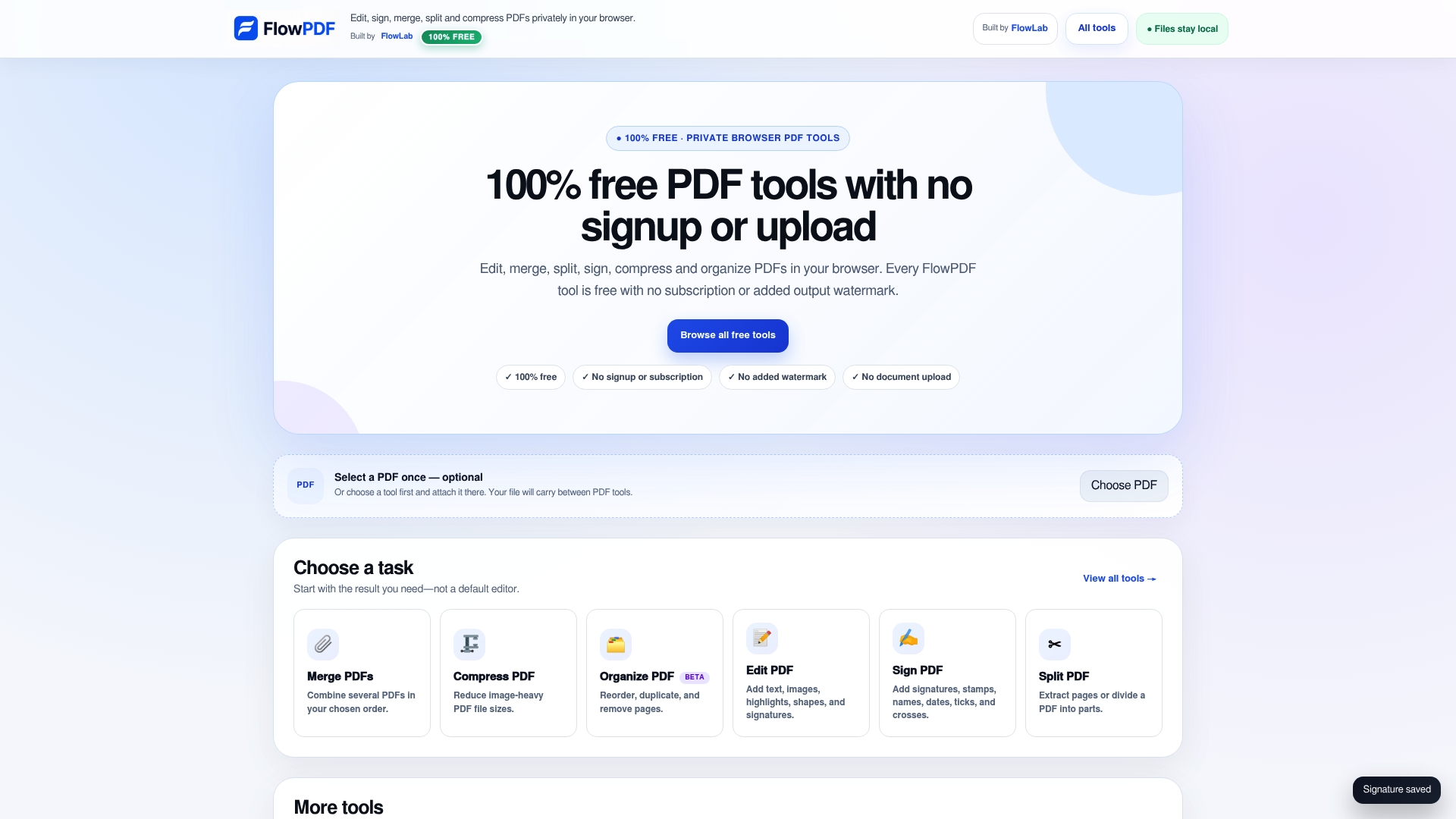
Beyond merging, some browser-based PDF tools include a full set of related features if your document needs more work before or after combining:
- Reorder or delete pages with the organize tool.
- Remove sensitive information first using the redact tool.
- Browse the complete toolset for editing, splitting, compressing, and more.
Try merging a non-sensitive file first to see how it works, then use it for the document that actually matters.
Primary sources and further reading
This article draws on Microsoft's documentation for built-in cloud merge features, an independent review roundup comparing browser, desktop, and paid PDF mergers, batch merge engineering notes on preserving bookmarks and forms, and open-source developer documentation on local, client-side merging.
Sources
- Merge and extract PDF files | Microsoft Learn
- Best PDF merger tools of 2026 | TechRadar
- Mergist — GitHub README
FAQ
Which PDF merger tool is best?
The right tool depends on your priority: for privacy and simple everyday merges, a browser tool that processes files locally, like FlowPDF, is a strong default since it skips uploads and watermarks. For large batch jobs or advanced bookmark preservation, a dedicated desktop or batch merge tool tends to serve better.
What is the best software to merge PDF files?
There's no single best software for every case: browser-based tools work well for quick, private merges, while desktop software suits heavy, repeated batch work. Checking whether a tool processes files locally or uploads them first, as outlined by independent reviews, is the most useful filter before choosing.
Can ChatGPT merge PDFs?
ChatGPT is a conversational AI tool, not a dedicated file-processing application, so it isn't built to merge PDF files directly. A purpose-built merger, whether browser-based or desktop, handles page ordering, bookmarks, and file integrity in ways a chat tool isn't designed for.
Does Microsoft 365 have a PDF combiner?
Yes, OneDrive and SharePoint include native Merge and Extract PDF options inside the PDF viewer's menu for licensed Microsoft 365 users. If the option doesn't appear, it may be a licensing or rollout issue worth checking with your IT support.