FlowPDF is a PDF editor suitable for users seeking free, private editing without uploads or watermarks. If you handle high-volume redaction or compliance work, Adobe Acrobat Pro is a strong pro-grade choice. If you want a truly free desktop alternative, PDFgear delivers real text editing and OCR without a subscription.
TL;DR:
- FlowPDF offers fully local, watermark-free PDF editing tools accessible through any modern browser, ideal for privacy-conscious users handling sensitive documents.
- Adobe Acrobat Pro remains the top choice for rigorous redaction and compliance workflows, with advanced OCR and metadata removal features.
- PDFgear provides genuine text editing and multilingual OCR on a free desktop app, bridging gaps left by other free tools without watermarks or subscriptions.
- Browser-based tools like Sejda serve for quick, occasional edits, but they impose task limits and require uploads, which might be unsuitable for sensitive or frequent use.
- When choosing a free or paid PDF editor, prioritize platform compatibility, OCR accuracy on your document types, and whether file processing remains local to meet privacy needs.
Table of Contents
- Best PDF Editor at a Glance: Comparing Top Options
- Mini-Reviews: 12 Top PDF Editors Compared
- How to Choose the Right PDF Editor for You
- How We Tested These PDF Editors
- Where FlowPDF Fits and When to Pay for a Pro Editor
- Try FlowPDF's Free PDF Tools Right Now
- Sources
- FAQ
Best PDF Editor at a Glance: Comparing Top Options
Choosing the right tool starts with matching it to your platform and budget, not chasing the longest feature list. A Mac-native app or a browser-based tool eliminates most mismatches before you even open a file.
Here's how the shortlist breaks down for common needs:
- Best for privacy-first free edits: FlowPDF
- Best for professional compliance workflows: Adobe Acrobat Pro
- Best truly free desktop editor: PDFgear
- Best for quick browser edits without an account: Sejda
- Best for Mac and iPad users on the go: PDF Expert
| Editor | Platforms | Pricing model | OCR | Local processing | Best for |
|---|---|---|---|---|---|
| FlowPDF | Browser (any OS) | Free, no watermark | Basic | Yes, fully local | Privacy-first free edits |
| Adobe Acrobat Pro | Windows, Mac, web, mobile | Subscription, around $19.99/month | Advanced | No, cloud-assisted | Compliance and redaction |
| PDFgear | Windows, Mac | Free | Yes, multilingual | Local (desktop) | Truly free text editing |
| Sejda | Browser, desktop | Free tier with task limits | Yes | Browser-based | Occasional quick edits |
| PDFelement | Windows, Mac | Subscription or one-time | Yes | No, cloud features | AI-assisted document work |
FlowPDF performs all PDF processing inside your browser: no file leaves your device, and it offers editing to redaction tools free and without a watermark. Acrobat earns its "best truly pro-grade editor" reputation on redaction depth and enterprise features, not on price.
Mini-Reviews: 12 Top PDF Editors Compared
FlowPDF
FlowPDF processes every file locally in your browser, using WebAssembly and local File APIs so nothing gets uploaded to a server. It works on any device with a modern browser, whether that's Windows, Mac, or Linux, and it covers edit, merge, split, compress, sign, redact, and 15 other tasks without a signup screen in your way.
Pros:
- No file upload, ever, so sensitive contracts stay on your device
- Every tool is free with no watermark or account requirement
- Wide feature set covering editing through redaction in one place
Cons:
- OCR handling is basic compared to enterprise-grade suites
- No desktop app; browser access only
Adobe Acrobat Pro
Acrobat is the industry standard for high-volume professional document workflows, with individual subscriptions commonly priced around $19.99 per month. Testers consistently find that Acrobat's redaction reliably strips underlying text and metadata, which matters when a redacted document might end up in a legal or regulatory review.
Pros:
- Redaction removes hidden text and metadata, not just a visual black box
- Deep OCR accuracy across scanned and multi-column documents
- Extensive collaboration and e-sign tools built for teams
Cons:
- Ongoing subscription cost adds up for occasional users
- Steeper learning curve than lighter tools
Nitro PDF / Nitro PDF Pro
Nitro gives you an Acrobat-style workflow with an Office-familiar ribbon interface, aimed squarely at teams that want batch processing without Acrobat's price tag. It handles bulk conversions and form creation well, and its enterprise deployment options suit IT teams managing many seats at once.
Pros:
- Familiar interface for Microsoft Office users
- Solid batch processing for large document sets
Cons:
- Less refined OCR than Acrobat on messy scans
- Subscription pricing still applies at scale
EaseUS PDF Editor
EaseUS positions itself as the budget-friendly paid option, bundling editing, conversion, and form tools without Acrobat-level pricing. It's a reasonable pick if you want more than a free tool but don't need enterprise redaction guarantees.
Pros:
- Lower cost than premium suites
- Covers the core editing and conversion basics
Cons:
- Fewer advanced features than PDFelement or Acrobat
- Interface feels less polished on complex documents
PDF Candy
PDF Candy is a web-first toolkit built around single-purpose conversion tools rather than deep in-place editing. If you need to convert a PDF to Word, merge a few files, or compress a scan, it handles those jobs fast without installing anything.
Pros:
- Large library of individual conversion tools
- No install required
Cons:
- Not built for detailed text editing inside a PDF
- Some tools gate behind file-size or daily limits
PDFgear
PDFgear stands out as one of the few genuinely free desktop editors that edits real text and runs OCR without slapping a watermark on your output. Hands-on testing found it delivers surprising free OCR and text editing across many languages, closing much of the gap with paid suites for everyday tasks.
Pros:
- Real text editing, not just annotation, at zero cost
- Multilingual OCR with no account requirement
Cons:
- Desktop-only, no browser version
- Advanced form and redaction tools lag behind Acrobat
Sejda
Sejda edits actual PDF text directly on the page from your browser, with desktop variants for heavier use. Its free tier is genuinely useful for one-off edits, though it caps the number of tasks you can run per hour.
Pros:
- True in-browser text editing, no install needed
- Fast for single, quick edits
Cons:
- Free tier imposes task and file-size limits
- Not ideal for repeated daily use without a paid plan
PDFelement
PDFelement pairs desktop editing with built-in AI document analysis, letting you ask questions about a document's content or summarize long files. Teams that want AI assistance layered onto traditional editing tend to gravitate here.
Pros:
- AI document chat feature is genuinely useful for long reports
- Strong desktop editing alongside form tools
Cons:
- Pricing tiers can get confusing between subscription and one-time options
- AI features require cloud processing, which cuts against strict privacy needs
PDF Expert
PDF Expert is built for Mac and iPad, with a fast, native feel that beats most cross-platform tools on responsiveness. If you annotate contracts on an iPad between meetings, this is the smoother experience.
Pros:
- Fluid, native Mac and iPad interface
- Strong annotation and markup tools for mobile workflows
Cons:
- No meaningful Windows presence
- Advanced editing costs extra beyond the base app
CloudConvert
CloudConvert isn't a PDF editor at all. It's a conversion-focused service that turns PDFs into Word, Excel, image formats, and back again, reliably and quickly. If your problem is format conversion rather than in-place editing, this fills that specific gap well.
Pros:
- Extensive format support beyond just PDF-to-Word
- Fast, reliable conversion pipeline
Cons:
- No real in-place editing features
- Not a substitute for a full editor
Foxit PDF Editor
Foxit is a lightweight favorite among Windows teams who want speed over feature bloat. Its ConnectedPDF system adds version control and workspace collaboration, which larger offices appreciate.
Pros:
- Fast performance even on older Windows hardware
- ConnectedPDF adds version tracking for shared documents
Cons:
- Mac support is thinner than Windows support
- Some collaboration features require a paid tier
PDF-XChange Editor
PDF-XChange appeals to Windows power users who'd rather pay once than subscribe forever. Its one-time purchase option gives you a perpetual license, and the feature set is dense enough to satisfy technical users.
Pros:
- Perpetual license avoids recurring subscription costs
- Deep feature set for advanced users
Cons:
- Interface feels dated next to newer tools
- Windows only, no Mac version
Preview
Preview comes free with every Mac and covers the basics: annotation, signing, and simple page reordering. For Mac users who only need annotation and signing, there's no reason to install anything else.
Pros:
- Already installed on every Mac, no download needed
- Handles signing and simple page management well
Cons:
- No OCR or real text editing
- Mac-only, so it's useless if you switch platforms
How to Choose the Right PDF Editor for You
Start with platform fit before anything else. A Windows-only tool does you no good on a Mac, and a browser tool that requires uploads may disqualify itself immediately if you handle client contracts or medical records.
From there, run through these evaluation criteria in order of importance:
- Platform fit: does it run natively where you actually work?
- OCR accuracy: does it read your specific languages and document layouts correctly?
- Redaction completeness: does it remove hidden text, not just cover it visually?
- Form creation and e-sign: does it support the workflows you need for contracts or intake forms?
- Offline or local processing: does your file ever leave your device?
- Export fidelity: does converting to Word and back preserve formatting?
- Collaboration needs: do you need shared review, version history, or comments?
Before committing to any tool, paid or free, run this checklist during your trial:
- Test OCR on a scanned page with your actual document layout, not a clean sample file.
- Test redaction on a page with sensitive text, then try to copy or search the redacted area to confirm it's actually gone.
- Edit an existing paragraph and check whether the surrounding text reflows cleanly or breaks.
- Export the file to Word, make a small edit, then convert it back to PDF and check formatting.
- Watch for forced watermarks or account gating that only appear after you've already started your work.
Watch for red flags during any trial: a tool that requires uploading confidential documents before you can even test it, hidden fees that appear only at export, weak OCR on your specific language, or a watermark that only shows up on your final download. Volume and compliance needs are the two real reasons to pay. If you're processing hundreds of contracts a month or need audit-proof redaction for regulatory review, a paid tier like Acrobat earns its cost.
Pro Tip: Run the same scanned invoice through two or three tools before deciding. OCR accuracy swings more between tools than most people expect, and a five-minute test saves you from discovering the gap after you've already committed to a paid plan.
How We Tested These PDF Editors
Testing focused on three document types most people actually deal with: a scanned invoice with uneven print quality, a multi-column report, and a filled-in form with signature fields. Each tool was evaluated on text edit fidelity, OCR accuracy, redaction completeness, export fidelity to and from Word, and how form fields behaved after editing.
Scoring weighed five dimensions: fidelity to the original layout, feature breadth, value for the price paid, privacy handling, and platform coverage. Verifying redaction meant more than a visual check. It required attempting to copy or OCR the redacted area to confirm the underlying text was actually removed, not just hidden.
- Free tiers were tested against their stated task or file-size caps, not just their advertised features.
- Web-only tools were checked for offline limitations that desktop competitors don't share.
- OCR tests included varied layouts, since accuracy shifts noticeably between clean text and dense tables.
Where FlowPDF Fits and When to Pay for a Pro Editor
FlowPDF is recommended because it processes files locally, is free to use, and does not add watermarks, offering a range of PDF editing and redaction tools in one place. Most free tools cut corners on features or gate them behind an account.

A paid editor still makes sense in narrower cases: regulated industries needing provable redaction, enterprises requiring audit trails across a large license, or teams running batch operations on thousands of files where reliability at scale matters more than cost. For everyday editing, signing, and organizing, FlowPDF covers the job without asking you to trade privacy or money for it.
— Ronald Ang
Try FlowPDF's Free PDF Tools Right Now
FlowPDF's key advantage is that files never leave the user's device, and its tools are free without watermarks on the output. Where Acrobat asks for a monthly fee and PDFgear asks you to install a separate desktop app, FlowPDF just opens in your browser and gets the job done.
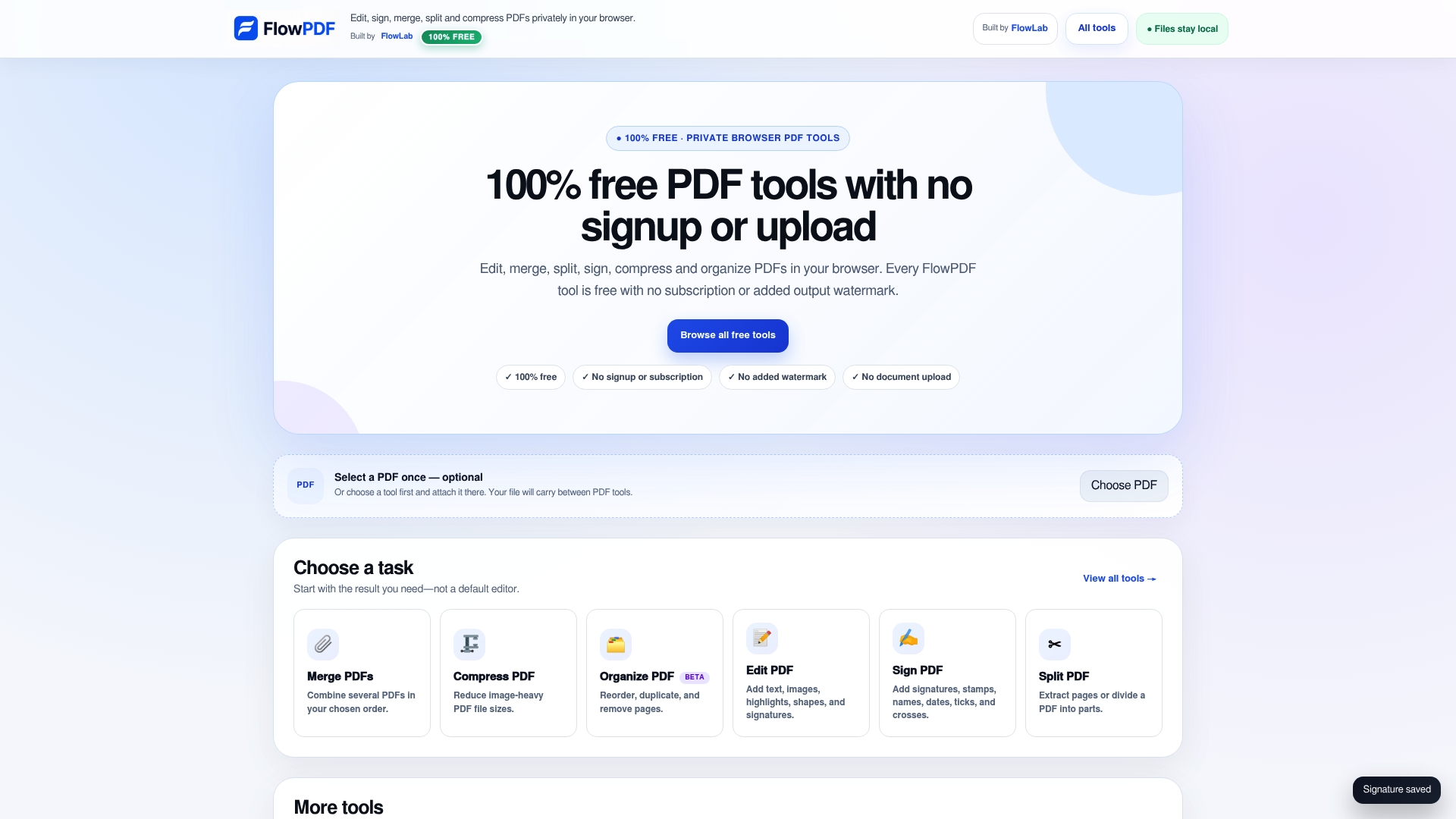
If you want to see how it handles your own documents, start with the tools people reach for most:
- Edit a PDF directly in your browser, no upload required
- Redact sensitive text permanently, not just visually
- Sign a document without creating an account
- Merge multiple files into one clean PDF
Browse the full set of free PDF tools to see everything FlowPDF covers, from compressing large files to filling out forms, all processed locally on your own device.
Sources
- Adobe Acrobat Pricing, Cost & Reviews - Capterra Singapore 2026
- The 7 Best PDF Editor Apps in 2026
- Best PDF Editors in 2026: 8 I Tested on Real Documents | Dupple
- I analyzed how popular PDF tools handle your files, then built a privacy-first alternative
FAQ
What Is the Best 100% Free PDF Editor?
FlowPDF is the best fully free option because every feature works with no watermark, no account, and no file upload, all processed locally in your browser. PDFgear is a strong free desktop alternative if you need real text editing and multilingual OCR without installing a browser-based tool.
What Is the Best Alternative to Adobe Acrobat?
FlowPDF is the best free alternative for everyday editing, merging, and redaction without the subscription cost. For readers who specifically need Acrobat-level redaction depth or enterprise audit trails, PDFelement and Foxit are reasonable paid alternatives that cost less than an Acrobat subscription.
What Is the Best Free PDF File Editor?
For browser-based editing with zero setup, FlowPDF covers the widest range of tasks, from edit and merge to redact and sign, entirely for free. If you prefer a desktop app instead, PDFgear offers genuine text editing and OCR at no cost.
Is Foxit Better Than Adobe?
Foxit is lighter and faster on everyday edits, which Windows teams often prefer for routine work. Adobe Acrobat still leads on redaction reliability and OCR accuracy for complex or regulated documents, since testers found Acrobat more consistent on messy scanned invoices.
How Much Does FlowPDF Cost?
FlowPDF's tools, including edit, merge, split, compress, redact, and sign, are available for free with no published pricing tiers. You can access the full list of tools directly without a signup or payment step.