
For most individuals and small teams, FlowPDF is the practical replacement for Adobe Acrobat. It runs entirely in your browser and handles core PDF tasks commonly needed by users. The exception is regulated enterprise work that requires certified audit trails or advanced preflight, where a certified enterprise platform still makes sense.
TL;DR:
- FlowPDF processes all files locally in your browser, ensuring total privacy without uploading sensitive documents to external servers.
- It covers essential PDF tasks such as editing, signing, redacting, merging, and compressing, suitable for small-team and personal use without requiring a paid subscription.
- The tool lacks enterprise features like certified audit trails and advanced preflight checks, making it unsuitable for regulated or highly compliant workflows.
- Testing with your actual files, especially large or complex documents, is crucial to verify feature accuracy and processing speed before fully switching.
- Reliable pricing relies on transparent or no-cost models, as unpredictable add-on fees often cause most organizations to leave Acrobat, according to recent industry analyses.
Table of Contents
- What Makes FlowPDF a Strong Adobe Acrobat Alternative?
- How Do You Evaluate an Adobe Acrobat Alternative?
- What Should You Expect From Each Core PDF Feature?
- How Do You Migrate From Acrobat Without Breaking Things?
- Are Electronic Signatures From Alternatives Legally Valid?
- Why FlowPDF Bets on Privacy Over Paid Features
- Try FlowPDF for Your Next PDF Task
- Sources
- FAQ
What Makes FlowPDF a Strong Adobe Acrobat Alternative?
Acrobat built its reputation on doing everything: editing, signing, redacting, converting, compressing. The question isn't whether Acrobat can do these things. It's whether you need a paid subscription to get them done. For the vast majority of everyday PDF work, you don't.
This tool covers many workflows for common Acrobat use cases. You can edit text and layout, merge and split files, compress bloated scans, redact sensitive content, sign documents, organize pages, rotate, extract, and convert images to PDF, all inside your browser tab.
Here's the FlowPDF workflow map:
- Editing — adjust text, images, and layout directly in the browser
- Merging and splitting — combine multiple files or pull specific pages out
- Compressing — shrink large scanned files without wrecking quality
- Redacting — permanently remove sensitive text, not just paint over it
- Signing — apply a signature without emailing the file anywhere
- Organizing — reorder, rotate, and delete pages in bulk
- Extracting and converting — pull pages out or turn images into PDF files
The privacy angle is where FlowPDF actually separates itself from most "free" competitors. Most browser-based PDF tools upload your file to a server, process it there, then send it back. That's a real risk if you're handling contracts, medical records, or anything with a client's name on it. FlowPDF processes files locally in your browser. Nothing gets uploaded, no account is required, and there's no watermark slapped across your finished document. This is an important feature. A 2026 comparison of Acrobat alternatives for teams found that predictable, transparent tools help reduce the license sprawl that makes Acrobat frustrating to budget for in the first place.
There are real limits, though, and pretending otherwise would do you a disservice. FlowPDF doesn't offer enterprise-grade audit trails for regulated signature workflows, advanced preflight checks for commercial print production, or the kind of accessibility tagging some government contracts require. If your organization needs ISO-certified document management or is bound by industry-specific compliance mandates, that's a different conversation, one a browser tool isn't built to have.
Pro Tip: Before you commit to any replacement, run your messiest real document through it first, not a clean test file. A scanned, slightly crooked invoice will tell you more about a tool's actual capability than a perfect PDF ever will.
For everyone else, freelancers editing contracts, small businesses managing invoices, students marking up research papers, the trade-off tips heavily in FlowPDF's favor. You get the features you actually use, none of the ones you don't, and you keep your documents off someone else's server.
How Do You Evaluate an Adobe Acrobat Alternative?
Choosing among the best Acrobat alternatives isn't about picking the flashiest interface. It's about testing specific, checkable criteria against your actual documents before you switch anything permanently. Here's the checklist that actually matters.
- Where does processing happen? Local, in-browser processing avoids the security exposure of uploading a file to a remote server. If confidentiality matters, desktop or local-in-browser processing is the safer default over cloud-based tools that quietly upload your file first.
- Does it cover your core feature set? Text editing, annotation, redaction, OCR, form filling, e-signatures, and PDF/A export for archiving. Skip any tool that's missing one you rely on weekly.
- How does it handle large or complex files? A 200-page scanned contract behaves very differently than a five-page memo. Test with your biggest file, not your smallest.
- What's the actual pricing model? Look past the headline number. Add-on modules, per-seat licensing, and storage tiers are where costs quietly balloon.
- Does it meet your compliance threshold? Most day-to-day signing and editing doesn't require certificate-backed audit trails. Some regulated processes do. Know which category your work falls into before you decide.
- Can you run a short pilot? Pick five to ten representative documents, run them through your candidate tool, and check the output against Acrobat's original.
Pricing deserves extra attention here, because it's the single biggest driver of switching. A 2026 industry analysis on Acrobat alternatives for teams found that teams often leave Acrobat not because of the subscription price alone, but because of unpredictable add-on costs stacking on top of it, extra modules, per-user tiers, storage charges that creep upward every renewal cycle. A tool with flat, transparent pricing (or no pricing at all) removes that budget guesswork entirely.
Security deserves the same scrutiny. Ask directly: does this tool upload my file to a server, even temporarily? Where is that server located? How long is data retained after processing? If a vendor can't answer these plainly, treat that as a signal, not an oversight.
A 2026 roundup that tested seven free PDF editors found that several free, web-based tools now cover editing, annotating, signing, OCR, and merging or splitting well enough to replace Acrobat Pro for most everyday users. This represents a meaningful shift from just a few years ago, when "free" usually meant "missing half the features you needed."
What Should You Expect From Each Core PDF Feature?
Every Acrobat alternative claims feature parity. Few actually deliver it evenly across every workflow. Here's what "good" looks like for each one, and how to verify it yourself during a trial.
Editing
Good editing preserves font rendering and layout exactly, whether the original PDF is vector-based (built from a design tool) or raster-based (a scanned image). Open a document with mixed fonts and columns, edit a paragraph, and check whether spacing shifts elsewhere on the page. If it does, that's a red flag for anything client-facing.
Annotation and review
Check whether comments and markup export and import cleanly, especially if you're collaborating with someone still using Acrobat. Sticky notes, highlights, and drawn markup should all survive a round trip without corrupting or disappearing.
Redaction
This is the feature most tools get quietly wrong. Visual redaction (a black box over text) is not the same as permanent removal. A proper redaction tool strips the underlying text from the content stream and scrubs hidden metadata, not just the visible layer. FlowPDF's redaction tool is built around that distinction. Test it by redacting a phrase, then trying to copy text from the "blacked out" area. If it copies, it's not actually redacted.
Forms
Verify that interactive form fields carry over correctly, and that data collected through filled forms exports in a usable format (CSV or FDF, typically). FlowPDF's form-filling tool handles standard field types without needing a plugin.
OCR
Run a scanned page through OCR and check accuracy against a clean printed page versus a slightly skewed or low-contrast scan. Language support matters if you're working outside English, and no current tool handles handwriting reliably, treat any claim otherwise with skepticism.
E-signatures
There's a real difference between a basic e-signature (a typed or drawn name applied to a document) and a certificate-backed digital signature (cryptographically tied to an identity and tamper-evident). Most everyday contracts only need the former, as explained in this e-signature platforms for sales teams compared overview. FlowPDF's signing tool covers that basic case entirely in the browser.
Page operations and compression
Speed matters more than people expect here. Tool responsiveness varies a lot: some editors process a batch of files almost instantly, while others lag badly on anything over a few dozen pages. That gap directly affects your daily productivity if you're processing files in volume, so time a batch job during your trial instead of assuming every tool performs the same.
How Do You Migrate From Acrobat Without Breaking Things?
Switching tools mid-project is where most migrations go wrong. A structured pilot removes the guesswork.
- Define your critical workflows first. List the five or six tasks your team does most often, editing, signing, redacting, whatever it is, and write down what "success" looks like for each.
- Build a representative test set. Pull real documents: a scanned invoice, a long contract, a form with fillable fields, and a design-tool PDF. Skip the clean sample files vendors provide.
- Test every workflow against that set. Check rendering fidelity, OCR accuracy, redaction completeness, form field integrity, signature validity, and PDF/A export where archiving matters.
- Roll out in phases. Start with one team or one document type, not the whole organization at once. Set rollback criteria before you start, so you know exactly when to pull back.
- Check downstream compatibility. Confirm your new tool's output still works with print shops, archive systems, and any client-facing portals that expect a specific PDF format.
Pro Tip: Keep your test corpus after the pilot. Six months from now, when a document behaves strangely, you'll want that same baseline set to compare against, not a fresh guess.
Are Electronic Signatures From Alternatives Legally Valid?
Singapore's Electronic Transactions Act sets the legal foundation here, and it's more permissive than most people assume.
The Act allows electronic records and many electronic signatures to be legally valid, provided the method used identifies the signer, indicates their intention to be bound, and is as reliable as appropriate for the circumstances surrounding the transaction.
In practice, that means a basic e-signature, typed name, drawn signature, or click-to-sign, is legally sufficient for most everyday business documents: standard contracts, internal approvals, service agreements. Guidance from Singapore's developer portal reinforces this: the appropriate signature method depends on the sensitivity of the transaction, not a blanket requirement for certified tools.
Certificate-backed digital signatures, cryptographically verified and harder to forge, become necessary for specific regulated processes: certain government filings, some financial transactions, and industries with their own audit mandates. For everything else, keep a copy of the signed document alongside basic audit metadata (timestamp, signer identity, IP if available), and you've covered your bases.

Why FlowPDF Bets on Privacy Over Paid Features
Most PDF tools chase feature bloat because it looks impressive on a pricing page. FlowPDF took a different bet: build the workflows people actually use, run them entirely in the browser, and never touch a server.

That decision comes from watching how people actually use PDF tools. A freelancer editing a client contract doesn't need a certification suite. They need to make an edit, sign it, and send it back without wondering where their file just traveled. A small business redacting a client's personal details before sharing a document doesn't need enterprise software. They need certainty that the redaction is real.
The honest caveat: if your organization needs certified audit trails, regulated compliance tooling, or enterprise-grade preflight, that's not what FlowPDF is built for, and it shouldn't pretend otherwise. For nearly everyone else, in-browser processing with no upload is simply the safer, cheaper default.
— Ronald Ang
Try FlowPDF for Your Next PDF Task
FlowPDF is the alternative to a paid Acrobat subscription for anyone tired of watermarks, upload limits, and per-seat licensing creeping up every renewal. Many common workflows like editing, signing, redacting, merging, splitting, compressing, and organizing are available and processed locally in your browser with no file ever leaving your device.
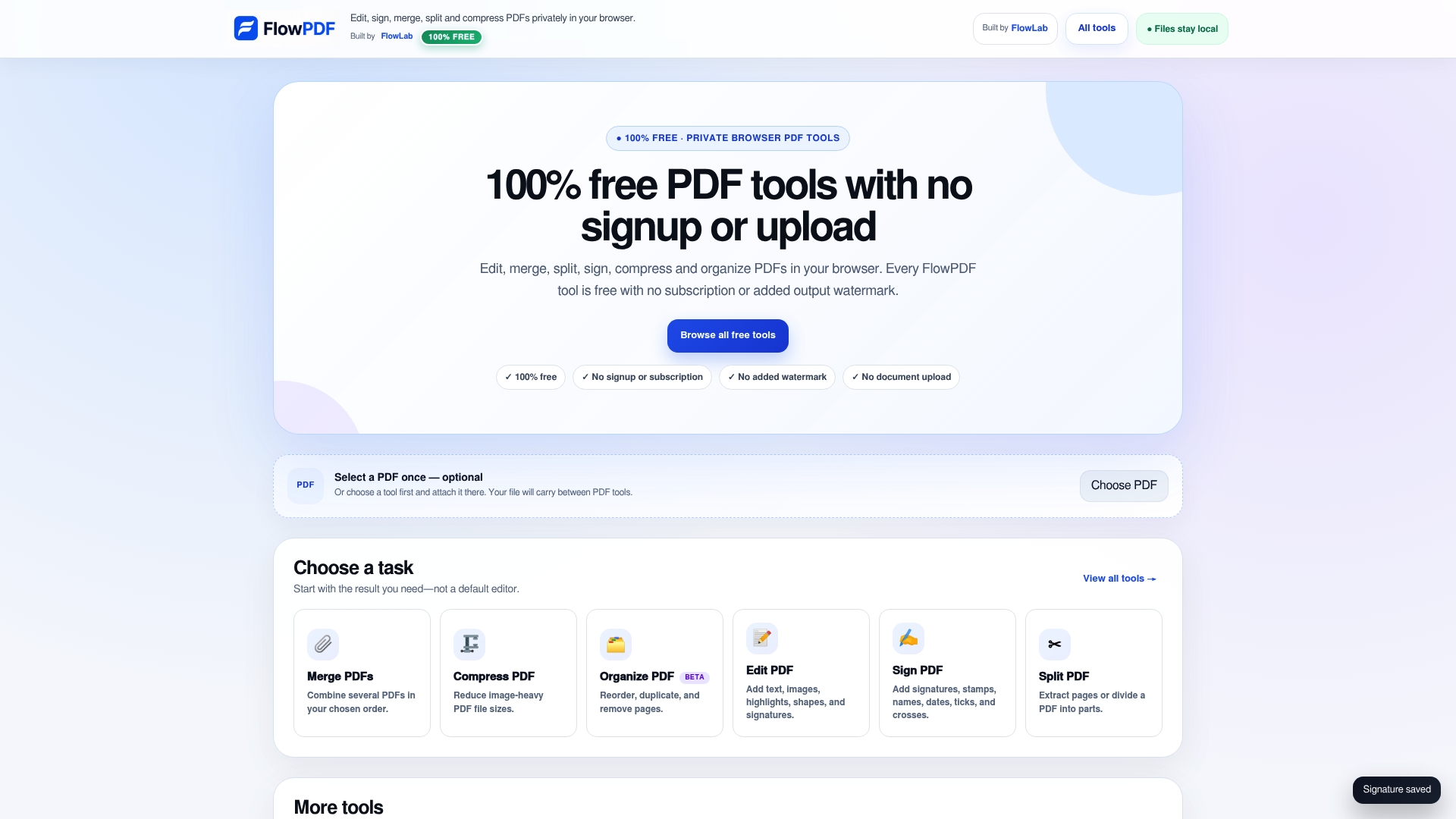
Start with a real test. Pick one document you'd normally send to Acrobat this week, a contract, a scanned form, a report that needs a signature, and run it through the full FlowPDF toolkit instead. If you need to strip sensitive details first, the redaction tool handles that permanently, not cosmetically. If you're consolidating multiple files, merge them privately without an account or a watermark. One test document is enough to see whether it fits your workflow before you decide to switch anything else over.
Sources
- Adobe Acrobat alternatives for teams in 2026 | CIO
- Electronic Transactions Act (Singapore) — statutory provisions
- Best Acrobat Alternatives 2026: 7 Free PDF Editors Tested
FAQ
Is There Still a Free Version of Adobe Acrobat?
Adobe offers a limited free Acrobat Reader for viewing PDFs, but editing, redacting, and advanced tools require a paid subscription. FlowPDF covers most of those paid workflows, including editing and signing, entirely for free.
Is There a Genuinely Free Alternative to Adobe Acrobat?
Yes. A 2026 testing roundup found that several free, web-based PDF tools now cover editing, annotating, signing, OCR, and merging or splitting well enough to replace Acrobat Pro for most everyday users. FlowPDF is one option that runs these workflows locally in your browser with no account, upload, or watermark required.
What Is the Best 100% Free PDF Editor?
The best free PDF editor depends on whether you need local processing for confidential files or just basic editing on non-sensitive documents. For privacy-focused editing without uploads, FlowPDF's edit tool processes files entirely in your browser at no cost.
Is Foxit Better Than Adobe Acrobat?
Foxit is generally positioned as a lower-cost commercial alternative to Acrobat with similar core editing and signing features, but it typically still requires a paid license for full functionality. If your priority is avoiding subscription costs entirely while keeping documents off external servers, a free browser-based tool like FlowPDF fits that need without any licensing fee.